Feature
A Commitment to the Special Relationship
Gabe Amo (2010)
From June 12 through June 16, the Association of Marshall Scholars convened the eighth annual AMS Legislative Exchange, bringing together members of the US Congress and the UK Parliament for an annual bipartisan, cross-party exchange with subject-matter experts, government officials, and leaders from civil society. Congressman Gabe Amo (2010) was a member of the US delegation this year as well as in 2025, and we spoke to him about the experience, and how he thinks about the work of upholding the special relationship as both a member of Congress and a Marshall Scholar.
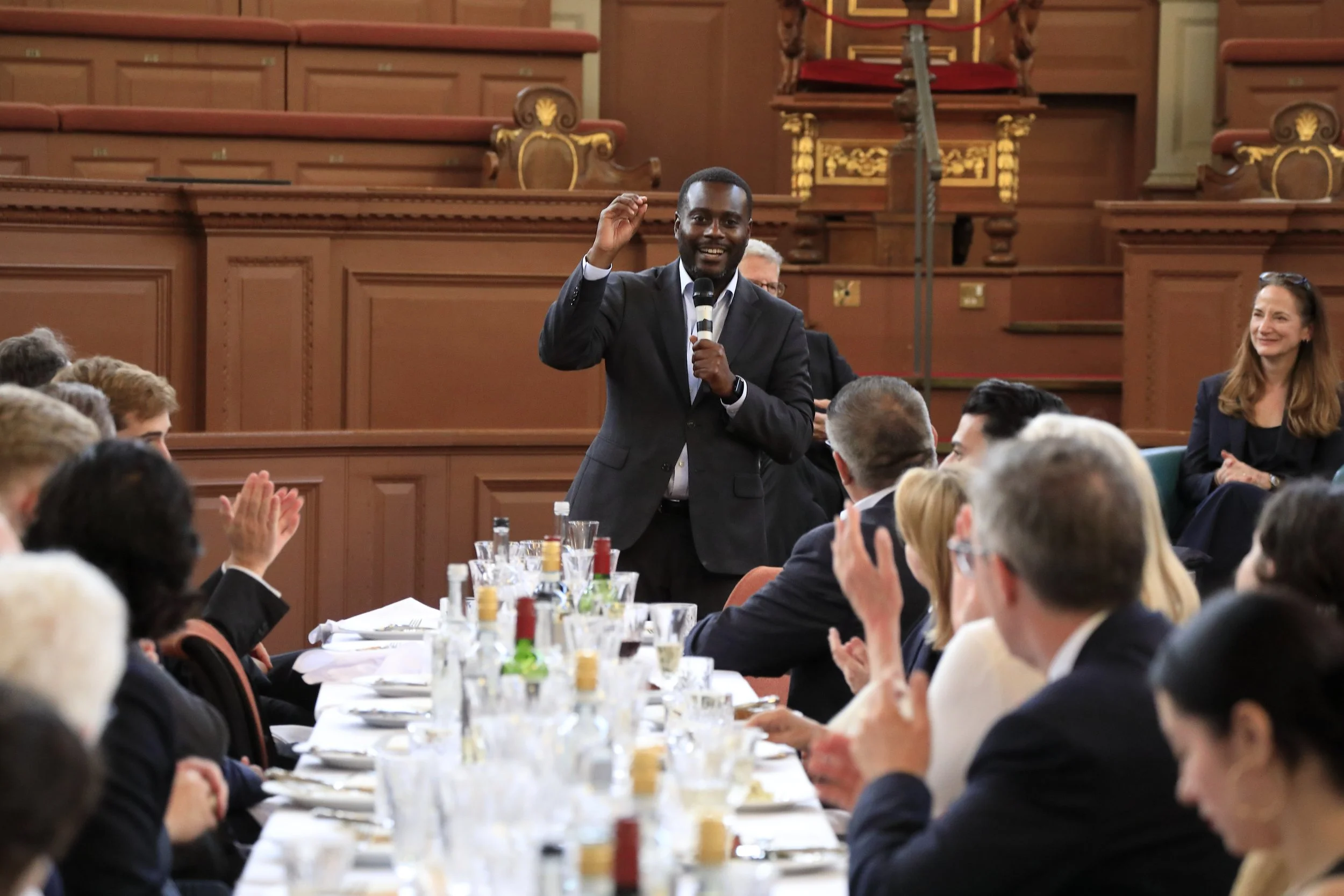
So over the course of five days you met with easily 180 participants, including 45 Marshall Scholars, and of course the delegation of seven members of Congress, and eight British MPs. What was that like?
It was obviously very meaningful as a Marshall – and now the only Marshall Scholar in Congress – to participate in the exchange.
I see it as the connective tissue that ties together the work in Congress and the ongoing contributions of the Scholarship to both our nations. It was a great opportunity to be alongside my colleagues and to share both my personal experience but also to see their interaction with Scholars.
How do you think being a Marshall Scholar as well as a member of Congress affected your experience?
As a beneficiary of the generous investment of the United Kingdom, my view always tends to be ambassadorial, both for the Scholarship, and for the country. And so while my colleagues certainly have a length of service in Congress, and represent our country in all sorts of ways, it was a special treat for me specifically.
Have there been conversations or interactions that stood out for you over the two exchanges?
I think that there were probably three big moments that meant a lot to me. One was the opportunity to engage in a dialogue about the future of our foreign policy at a moment when I think any objective observer would suggest that the global order is changing in real time. To have our closest ally processing and experiencing that change with us in real time was very valuable: an adjustment, perhaps, of our expectations of one another as nations, and a chance to engage with the people who will be writing the rules of the road for an uncertain future.
To say the least. And the other two standouts?
Well, the chance to spend time with current Scholars at our events in Oxford, Cambridge, and London, and time with past Scholars. Seeing that the future of AI has Marshall Scholars deeply intertwined.
And then the last part – as you know, in 2025, we engaged with the Secretary of State for Business and Trade while a real- time conversation around tariffs and tariff announcements was happening. We were able to see, at the highest levels of UK government, a commitment to the special relationship and a desire to maintain it.
Certainly while we were there, events were somewhat dramatic in nature, and yet I heard affirmations from everyone we encountered, whether it was in business or defense or trade, who said time and again, we are committed. It may look different going forward, but we’re committed. Also very importantly, our Congressional delegation began to have conversations amongst ourselves about how we were going to take our reflections back home to the United States. I think that’s the exchange part of all of it, that it’s not just contemplative in the moment, but that we return home to actually address some of the things we’ve learned.
It’s probably too early to say for this year, but have you seen any specific outcomes or policies that you think were connected to the aftermath of the last year’s exchange?
For me personally, there is a renewed commitment to advancing the security agreement, both because of my Congressional district and my work on the Foreign Affairs Committee. It was important for me to address and to raise the national security collaboration in the form of the AUKUS [Australia, United Kingdom, United States] Agreement, and to hear how much our UK friends were also intent on its success. And as a result, I helped pass something called the AUKUS Improvement Act, which was part of the NDAA [National Defense Authorization Act] legislation that’s passed every year. So that was definitely a key takeaway for me.
Obviously there’s a lot in flux right now. I would imagine you try to take both the short and the long view. So pulling back and thinking about the longer-term US-UK dynamic, what’s front of mind, and what are you thinking about as areas of collaboration and partnership?
Look, I think some of the key areas of partnership remain the mutual strengths we have in higher education. And our commitment to – and it might look different – but our commitment to peace and stability.
While this current administration may have a different approach, I do believe that our leadership, the leadership of both the US
and the UK, makes the world better. That’s something that lasts beyond the tenure of any particular officeholders, and it’s certainly something that I’m personally committed to. I think we can still build upon those shared areas. That’s what we saw when we were there. Because it wasn’t just government officials, right? It wasn’t just academia, or business. It wasn’t siloed. It was the collaboration across many fields.
I think that’s how we have to treat this. It’s the engagement across sectors across countries. That’s what I hope this AMS Legislative Exchange can help foster. Of course, it is legislative in nature – we’ve got members of Congress and Members of Parliament – but my hope is that there is something really interesting and meaningful that extends beyond it. It’s not just in Congress. There are things I can take to stakeholders in my state, in my constituency, to say, here’s something that I’ve learned, here’s something that you have to get involved with. I have institutions of higher learning in my district, from Brown University to the Rhode Island School of Design to Bryant University, that all have a focus on their international relationships. So I’m hopeful that that’s a component we can build upon in future exchanges.
Of course, not all of us are Members of Congress. But as you think about other Scholars, whether they are folks who are far along in their careers or Scholars who have just finished their time in the UK, what would you say to us? What is our role in maintaining the special relationship, and is there anything we should have in mind?
I would say that we have a great responsibility as Marshall Scholars to steward the relationship, not only in our fields of work, but more generally to protect and preserve these really important ties we built.
To put it another way, you don’t have to be a Member of Congress to be an ambassador for the relationship, for the collaboration and for the spirit of the Scholarship. You know, it was a gift of thanks originally, and the way you demonstrate appreciation is by paying it forward, in our deep engagement with the world and in our deep engagement with our professions. That’s the contribution that I think outlasts the length of time we spent in the UK. That’s what makes the relationship special – that there is this wonderful feedback loop of Marshall Scholar contributions to the world.
Last question. As you’ll recall, when we go through the application process, we have to pitch the UK government on what we’re going to do as Marshalls and why we’re a good investment. Do you remember what you said, and is that what you ended up doing?
I’d have to go back and look it up to be positive, but I’m pretty sure that I said I’d be in elected office one day.
Oh, so you nailed it.
Well, you know, promise kept.

Gabe Amo (Class of 2010, University of Oxford) has served as the U.S. Representative for Rhode Island's 1st congressional district since 2023. Before running for Congress, Amo worked in the Biden administration as the deputy director of the White House Office of Intergovernmental Affairs.