
Feature
Giving Life to the Unexpected
Avery Willis Hoffman (2000)
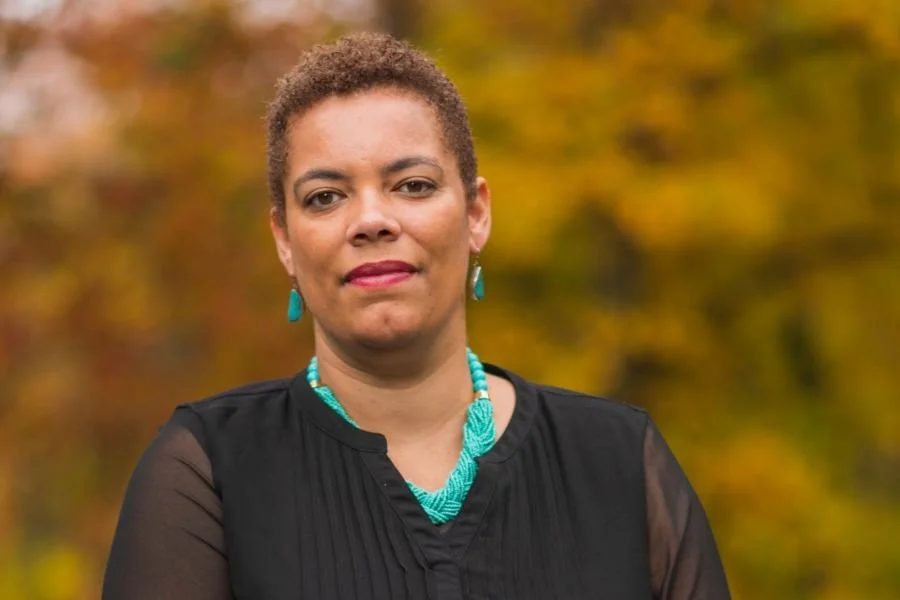
As the newly named Artistic Director of the Court Theatre in Chicago, Avery Willis Hoffman (2000) is taking big swings. She sat down to talk with us about how live theatre is changing, what remains the same across eras, and how she’d like to see us think differently about the arts. She also reflected on her family legacy with the Marshall Scholarship and her path to where she is today.
Many congratulations on your new role as Artistic Director at the Court Theatre in Chicago. This is a very important role! But also perhaps a mysterious one to many of us who do not work in theatre. What does an artistic director actually do?
Ha. Yes. That is a very good question. It is almost an existential question. So traditionally – and I’ll emphasize “traditionally”
– an artistic director is the person responsible for the artistic programming of a theatre. They work with a team of folks across the marketing and production and administrative teams to think about play selection, to think about the audience of a place, and to understand the types of plays or musicals or operas or dances that audience has particularly responded to in the past or might respond to in the future. It’s a little bit of an alchemy exercise to take into consideration all these elements and mix them together to create a season.
One gets the impression that maybe you are not going to do things in the traditional fashion.
I’ve been thinking a lot about what the role could be and how it might evolve for our particular time. For example, traditionally artistic director was not a very collaborative role. An artistic director ruled and made decisions. Also, traditionally, many artistic directors also direct. Depending on the size of a season, they may direct several productions within that season.
I have chosen, at least recently, not to direct but to be more of a curator and more of a producer – a dramaturge. That means advising and working closely with directors on their particular productions and acting as a guiding force and a sounding board for ideas, but being less in the weeds of the making of a show.
It sounds like a specific set of choices you’re making in the context of a system that has generally worked in one way. Why?
Any theatre has always been collaborative. A director is always working with a scenic designer, an audio designer, a costume designer. The nature of theatre is, in essence, collaborative, which is wonderful. I’m really interested in bringing leadership back into a collaborative position too, away from a dictatorial one.
Collaboration, especially in the arts, makes everything stronger. It makes our human relationships stronger, it makes our productions stronger. There’s input from multiple directions. I want to move towards a theatre of care.
Tell us more about that. What is a theatre of care? What does that mean?
It’s a whole concept, a movement that I’m really interested in exploring and thinking deeply about. Coming out of the pandemic, there was this new thought around sweat equity, that we’re not going to kill ourselves making art anymore. We’re not going to be putting in excessive hours, and we’re moving away from that mentality of “the show must go on” at whatever cost.
Instead, a theatre of care looks like putting ourselves into positions that invite us to care for each other. I think that does really lead to better and more thoughtful productions, because you’re not exhausted all the time and trying to hang on for dear life.
Beyond the romantic image of the struggling artist, who suffers nobly to make art, there’s also the economic reality of declining ticket sales, of the business model of the theatre itself struggling in our current context. How do you see that landscape functioning?
It’s a difficult intersection, and I think we will need time to evolve towards a better model. If we’re thinking about the number of hours we’re putting in weekly and daily, and trying to find a more humane model, something has to give on the other end. Frankly, it means that people have to do fewer shows and do less.
The business side is not evolving as quickly as the conceptual idea of a theatre of care. Part of our work is to align those two. That can look like getting people on payroll, offering benefits. Equally, we have to think about where the funding is coming from, to properly care for people and give them what they need. It’s a huge expense. But if we can do that, maybe it also eliminates the necessity for the constant, exhausting hustle, where an actor has to have four jobs at once just to make ends meet.
I’m interested in moving away from the era of starving artists. While some of it perhaps inspires people to do amazing work, I do believe that if you care for people, you’re going to have a better result. Because when people don’t have to stress about where their next paycheck is coming from, or do two or three other jobs just to barely pay the bills, they can turn that energy to making art.
It’s a long process. It’s going to take time. But I’m hopeful that there’s movement towards making that change.
Beyond the romantic image of the struggling artist, who suffers nobly to make art, there’s also the economic reality of declining ticket sales, of the business model of the theatre itself struggling in our current context. How do you see that landscape functioning?
The arts are essential to our well-being. They’re essential to who we are as humans. The making of art is a particularly human activity. Many folks think of art as entertainment, as an ancillary: if we have a little bit of extra money this month, we’ll go to the theatre or go to the movies. It’s an extra.
But if it’s essential to make art, to support art, that becomes a different mindset. It’s very challenging right now, for lots of reasons. We have all these concurrent challenges – we must tackle this new crisis in health care, or that local fire department that needs support – many valid needs, and once again, the arts are pushed to the side. But we are all responsible for supporting the things that are essential to human beings. That’s my particular philosophy. Obviously not everyone shares that. But what does it mean to go to the theatre and support it with your hard-earned money? You don’t need millions of dollars of extra money or huge tax breaks to support the children’s theatre in your town or your local art gallery. All of us are patrons, in some way, shape, or form.
The community of artists and those who support the arts have to think differently and come up with new structures, because the old structures are being dismantled, and it’ll be very hard to resurrect them. And maybe, many of those old structures were flawed in the first place.
There’s a lot of discourse around how all of our brains have turned to mush, no one has an attention span, we’re all just mindlessly scrolling – a lot of doom-saying. What are you seeing in the real world? What are audiences interested in today? What do they care about?
Human interaction is still vitally important. Sitting next to a stranger, experiencing the same show, maybe striking up a conversation at intermission about what you’re seeing and what you like or don’t like. It’s even better when you don’t like it, in fact, because you can have a debate about it. Your brain is activated and you are having a human-to-human experience that technology can never replace.
There is a drop-off since the pandemic. That’s true. But the people who are back are engaged, and are looking forward to that time away from their phones. When you see live theatre, you are in a mode of existence for an hour or two that you will never experience again in exactly the same way, even if you see the same show again. That fleeting live experience is not replicable.
I see a lot of folks coming to the theatre by themselves, and when they get there, they find a community. That is very important, and very special. Even if you never talk to another person, you are in the company of other people, doing something communal. It helps to relieve loneliness. Also, I find – and this is particularly true at Court, which I love – that there’s an intellectual vitality around the pieces and an acknowledgment that it’s taken extraordinary work to make the production happen. There’s a different kind of applause that audiences are giving back to the actors and it really feels genuine and good.
This intersection of theatre and politics and power and public experience was in many ways at the core of your work at Oxford. How do you think your work there inflects what you’re doing now?
My time in Oxford as a Marshall Scholar was such a rich, rich time for a lot of reasons. Academically speaking, as an undergraduate classics major, the opportunity to go to Oxford where some of the best classicists were working, to ground really deeply in these ancient cultures, was beautiful. I could really steep myself in it. My master’s and DPhil work focused on modern adaptations of Greek tragedy, which was a little revolutionary at the time, and particularly on one play, Euripides’ Trojan Women. I spent years studying that play, not just in its ancient context, but also in its modern one.
What I loved was being able to dig deeply into the topics and themes of the original work, but also to see how directors, designers, choreographers, and composers were thinking about this one particular play as a political weapon, as a way of saying something about their times, whether that was the First World War, or the Korean War, or the wars in Afghanistan and Iraq. You see this play become an anti-war cry.
Theatre has always been wielded politically. All the way from the Greeks on. And that’s what I carry with me most: the ways in which the different elements of theatre, from sound to music to costumes to set to direction, can create a world where people can enter and see differently, where they can see a kaleidoscope of thoughts around something that they thought they already knew all about.
You’re not the first Marshall in your family – in fact, you have a family legacy with the Scholarship.
It’s something I think about a lot, for many reasons. My dad [Dr. John Willis] got his PhD at SOAS in London on a Marshall Scholarship. He was in the class of 1963, and he was the first African American Scholar. I remember him often saying that in the UK, he could be himself, and he could be an intellectual.
He found an intellectual home in the UK, a place that embraced him as a scholar and as an academic. That’s not unique to him; there were many folks, artists and writers like Josephine Baker and James Baldwin, who really found their place in Europe because they were treated so horribly in the US.
So when he came back to the US, he came back with a confidence that really led him through his career. He taught at the University of Wisconsin, at Berkeley, and he spent most of his career at Princeton. I think he always brought with him the deep intellectual rigor of the UK, and he instilled that in me – that it’s important to be educated, to be thoughtful, to not hide away your intellectual curiosity but to embrace it and really pursue it. As he navigated his own experiences with racism and segregation, he leaned on his intellectual prowess and his degrees, and I think he wanted me to know that those things were a way of saying, you are important and you are a full human. And I think that’s partly why I went down the academic route for so long, because he showed me the value of that life.
Do you remember what you said at your Marshall interview, about what you said you would do with your life? How did that match up with where you’ve found yourself?
You know, it’s funny because I think what I remember most was having such a rich and fabulous conversation in my interview, which surprised me, because I was expecting a grilling. And I had gone through the Rhodes process as well and – yeah. That was not fun. So I was bracing for that.
I remember that I was very clear about what I wanted to do at Oxford; I even knew what play I wanted to work on. I think the surprise was that I really thought I would get an academic position and go into the scholarly world. What I discovered across my time as a Marshall, because I was deeply involved in theatre there, and I even directed Trojan Women at the Oxford Playhouse, was that I needed to be in that live interpretation of something I had studied for years. I had been there all along. I just hadn’t realized that I could have an artistic career.
My father’s first cousin was Toni Morrison; he brought her to Princeton, and she was there as I was growing up, and she was an incredible mentor to me. I used to write all these little adventure stories and I’d give them to her. They’d come back with everything redlined out. She was an incredible editor and she encouraged me. But the thing that kept me from being a writer fully was the theatre. And Toni really understood that, too. She did theatre as a young person.
It goes back to that collaborative spirit we talked about. Writing is so lonely. You can go to great depths and great heights, and it can be joyful, but it is so solitary. I was a truly social person, and I wanted to be around other people, making things together. So at first it was acting, and then it was being more of a director or a producer, but both my idea of being a writer and my idea of being an academic kept getting disrupted by theatre. It was the thread.
And so after I finished my DPhil, I thought, I might just give this a go for real as an actual occupation and not just this wonderful challenging thing that I do alongside everything else. So I’m certainly doing the things that I hoped I would be doing, which is really wonderful.
Avery Willis Hoffman (Class of 2000, University of Oxford) is the Marilyn F. Vitale Artistic Director of Court Theatre. She is a visionary leader and producer with over two decades of experience in theatre, opera, music, and interdisciplinary performance.