
Feature
The Pursuit of Knowing Who We Are
Janet Burroway (1958)
An acclaimed novelist, playwright, and educator, Janet Burroway (1958) has authored nine novels and two of the most widely used creative writing textbooks. Nearly seven decades after studying at Cambridge as a Marshall Scholar, she continues to explore questions of identity and self-discovery through her writing. Her latest novel, Simone in Pieces, reflects a lifetime of experiences shaped by resilience and her enduring connection to the United Kingdom.
The Mademoiselle Experience
One thing, at least, was very clear to Janet Burroway during that summer of 1955 in New York City. She was not a magazine girl. Burroway had been chosen as a guest editor, one of twenty promising young women from colleges across the United States brought to the city in June to help put together Mademoiselle magazine’s August college issue. It was a terrifically prestigious thing: Joan Didion numbered among the twenty that same year, and so did Jane Truslow, Gael Greene, and Adri Steckling. Sylvia Plath had been a guest editor two years earlier, during the queer, sultry summer she would later chronicle in The Bell Jar.
Plucked from the University of Arizona, Burroway was painfully self-aware, a country mouse from the desert suddenly thrust into a very different world. “Everyone else seemed to know what they were doing and seemed to be getting it done fast and well,” Burroway wrote home in a letter that summer. “I faked it in Milliken plaids and an energy that verged on shrill,” Burroway wrote later of the
experience, “and it did not then occur to me that any of the others could be scared and judgmental in equal parts.” The Mademoiselle guest editorship was a whirlwind of parties and fashion shows and cranking out editorial prose in the obligatory chipper house style. To hear Burroway describe the experience now, it sounds like Mad Men meets The Devil Wears Prada. But despite the cachet and the glamour – “it was terrifically exciting,” Burroway recalls, describing expensive dinners and carriage rides in Central Park and a ball on the roof of the St. Regis where she wore a cloud of flame-colored nylon – working on the magazine itself wasn’t all she had imagined. “I’m so sick of writing little news stories and having them edited from bad to worse,” Burroway complained to her parents in a different letter. Life in the Mademoiselle offices was loud, busy, and by turns boring and terrifying; not what she had imagined as the life of a writer.
“It was noisy in a screechy kind of way all day long,” Burroway says. “I was put off writing for a magazine because I had the clear sense that it was not how I wanted to spend my days. I was not still, at that point, clear about whether I wanted to pursue fashion or writing or acting, but it was in that period that I thought, this is what I want to do, but I want to do it on my own.”
The Cambridge Connection
There is no question that during the intervening seven decades, she has explored nearly every version of what it can mean to be a writer. Following her summer in New York, Burroway finished her undergraduate education at Barnard, and was a member of the fifth class of Marshall Scholars to head to the UK in 1958. She read English at Cambridge, followed by study at the Yale School of Drama from 1960-1961. She has published poems, plays, essays, children’s books, and nine novels, including her most recent, Simone in Pieces. She is widely acclaimed for having written two of the most popular textbooks in writing pedagogy: Writing Fiction: A Guide to Narrative Craft (University of Chicago Press, now in its tenth edition), and Imaginative Writing: The Elements of Craft (Pearson, now in its fifth).
In addition to her success as an author, Burroway has had a long and bravura career as an academic both in the US and the UK. She has taught at the University of Sussex, England, where she also designed costumes for the National Theatre of Belgium. She taught at the University of Illinois, the Writer’s Workshop at the University of Iowa, Florida State University at Tallahassee (1972-2002), and most recently in the MA/ MFA Writing Program at Northwestern. She is a Robert O. Lawton Distinguished Professor Emerita from FSU, and in 2014 received a Lifetime Achievement Award in Writing from the Humanities Council of Florida.
Today, at almost ninety years old, she sports a sleek blue bob, dyed to match her granddaughter’s. Despite her decades of accomplishment, Burroway remains vibrantly curious, a wide-ranging thinker still exploring the questions that she started to ask during that summer in New York City about who she is and what it means to be a working writer. “I have enormous respect for the English sentence,” she says. “The ambiguity and fluidity of the English language is just my cup of tea.”
Although Burroway’s greatest commercial success has come from her textbooks, her critical reception has been positive for decades. Nevertheless, she is increasingly narrow-eyed about the viability of contemporary publishing. Simone in Pieces is her first novel to not be published by a major house, and Burroway harbors no illusions as to why. “I started with my editor sending it out to...the Big Five,” Burroway said in an interview. “She sent it out to about thirty people, all of whom said exactly the same thing: Beautiful writing, wonderful novel, not for us. And it is very clear to me what that means. We can’t make money on it.”
Reflections on Literary Success and Simone in Pieces
“This admission,” she says, “I freely make to anyone. I could also wish that I were known for my novels instead. But I’m very grateful for the craft books. I have met wonderful people and been wonderful places because of them. And they still make money.” Burroway is nothing if not a realist as well as an artist. In a 2010 essay called “Best Advice,” she wrote the following: You have to earn a living somehow, and doing so is honorable, even if your spirit bleeds a little. But when you find yourself as a writer taking on more and more of the tasks that seem not quite true (you know them because they register in the body: your heart sinks half an inch, your stomach makes a quarter turn, there’s a semiquaver in your throat), then it is time to say no and turn to greet the next blank page. Because the core joy of writing, the ecstase, is not in the publication, the review, the prize, or the applause, but in that magic moment when you get outside the bone box of your own mind.
Janet Burroway has been chasing those magic moments her whole life, on both sides of the Atlantic. “I remember that in the fifties,” said Burroway in another interview, “we were from time to time advised to ‘just be yourself.’ This made no sense to me. How could you be anybody else than yourself? I had no doubt who I was! However, I was largely wrong. And at eighty-nine I am still in pursuit of knowing who I am.”
The lifelong effort to discover who one is lies at the center of Burroway’s latest novel, Simone in Pieces. It traces the life of the central character, Simone Lerrante, through a kaleidoscope of voices and points of view (“somewhere between twelve and sixteen,” says Burroway), all circling around the central object of Simone. These refracted viewpoints of Simone – both in how she sees and understands herself and how she is seen and understood by others – build up through war, immigration, divorce, death, and rebirth, slowly revealing an understanding of the self that Simone – and Burroway – are both pursuing.
The novel didn’t start out so seriously. “It was [originally] a satirical short story,” says Burroway. “I was going to write about an English Department [faculty] meeting. I’d just been to such a meeting in Tallahassee where I taught for thirty years, and I confess that it was absolutely based on them.” As clever and biting as the faculty meeting story was, it was just a seed; Burroway spent years working on the novel to bring it to its full form. Over the course of three decades, she says, “I kept coming back to it and then going away from it and writing something else – several books, actually.”
Cambridge's Influence
Burroway credits her endurance to a particularly English sensibility she first learned in Cambridge. “I think I absorbed a little bit of that keep calm, carry on – let’s just get it done day to day. And I have needed that in my writing, because I do not write easily. Or rather, I think very slowly. I write fast.” Burroway kept circling back to Simone, and over time Simone’s story became one that also drew upon Burroway’s own loves and lives on both sides of the Atlantic.
Burroway’s two marriages have both been to men who were immigrants to America after World War II, and those relationships certainly echo on the page. Even more pronounced and formative, though, in Burroway’s view (and, it must be said, for the reader), are the relationships with her mothers-in-law and how those have found their way into Simone’s story and into her own sense of self. “They were very different women,” says Burroway of her mothers-in-law. “One of them was an immigrant and the other was the mother of an immigrant who did not herself leave Belgium. But I talked to her about what she’d gone through in the war. She was a very self-contained person.”
“My second mother-in-law,” Burroway continues, “was a very warm person, just a puddle of love. She immigrated from Hungary after the war, and came to America at a time when America was very welcoming, very unlike now.” Struggling to feed children in desperate circumstances, the gradual and then sudden injection of terror and fascism into everyday life, seeing the fabric of your whole world torn up in front of your eyes and yet remaining the same – all these experiences are given voice in Burroway’s novel through different characters, as she moves from Europe to America through decades with great facility and fluency.
Like Simone’s journey, Burroway’s own life in letters has been inextricably tied to the UK. She still thinks of the Marshall Scholarship as a watershed moment. “In every way,” she says, “it transformed, not just informed, my whole life. I can’t imagine who I would be if I had not gotten that Scholarship.”
Excerpt from Simone in Pieces
Readers first meet Simone Lerrante, a Belgian war orphan, as a child refugee in Sussex, England, her memory damaged by trauma. This novel offers a kaleidoscopic vision of her fractured life and piecemeal understanding of self across multiple points of view. Following her from Cambridge to New York City and across the United States – through a disastrous marriage, thwarted desire, and the purgatory of academic backwaters – the novel charts Simone’s unexpected reconnection with her past, which provides both autonomy and inspiration for her future. Janet Burroway slowly reveals a multifaceted, fascinating protagonist, who observes her own life without always allowing herself to be immersed in it. Spanning seven decades, this story is both epic and contained, rewarding readers at every turn.
BY JANET BURROWAY (1958)
Simone free-wheels down Suttling Hill, legs out in front although she has tucked her wide skirt under, in which position she shows a bit of thigh. The bicycle belongs to Mr. Heywood, and Mrs. Heywood did not think it proper for a girl. But if Simone was to go up the shops as a matter of course there was no alternative, and in this instance Mr. Heywood prevailed.
Everybody in Suttling says “go up the shops” though the village is in the valley and almost everybody must descend to them. This kind of thing makes Simone laugh, and when she points it out to the greengrocer and the bakery lady, they laugh with her. She is well liked in town – an enthusiastic presence. She has once or twice deliberately forgotten something so that Mrs. Heywood, after a “Tsk!” of exasperation, will send her freewheeling down Suttling Hill to go up the shops again.
At village center is a curving hedge leading to a row of half-timbered commissaries, a pub called The Green Knight, and an arched stone bridge over a stream locally referred to as the River Wen. There is a whitewashed church with a steeple and a four- hundred-year history. The rectory garden is full now, in early autumn, of faded beauty. Simone leans in and scoops a handful of rose petals into her basket, then hurries to the baker for soda bread, to the greengrocer for a pound of sprouts, and on to the butcher shop,where massive Spencer Duff stands in an apron as wide as her bedsheet.
“A half a pound of chicken livers,” she says to Duff, and wrinkles up her nose at the shiny knobs of offal he presents to her. This makes him laugh, but he thinks she is a lucky girl. A decade ago there were all kinds of volunteers to take in the little refugees. Now it is a generous oddity for the Heywoods to be housing a young woman who spends the bulk of her time in school. The labor force needs women, and she could make a useful shopgirl or nurse. But he beams at her. She’s bright, and the bright can be lucky in this postwar economy.
Simone stows her bag and pushes off, detouring to the little bridge, where she stops and squints upriver in the hope of a swan. Sometimes there are swans.
“Mind you come straight home,” Mrs. Heywood always says.
What now serves for home is a brick bungalow called The Gote, which is not a misspelling of the animal but an ancient term for a water channel, in this case basically a ditch along the garden.
Mrs. Heywood is a person of wide-ranging skills. She can sew, embroider, needlepoint, knit, tat, cook, garden, organize a charity jumble or a wedding shower and arrange the flowers on the day. Now, having acquiesced to Teddy Moxham’s (and her husband’s) notion of taking in a student, she has determined to teach Simone the skills of which the girl is so obviously in need.
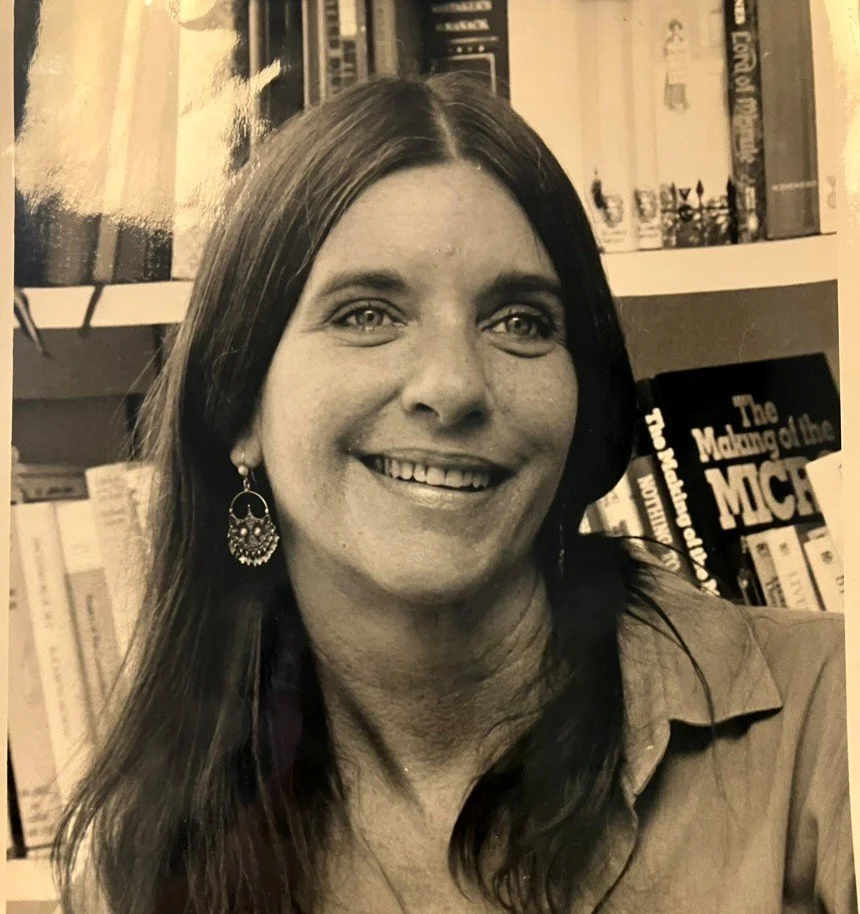
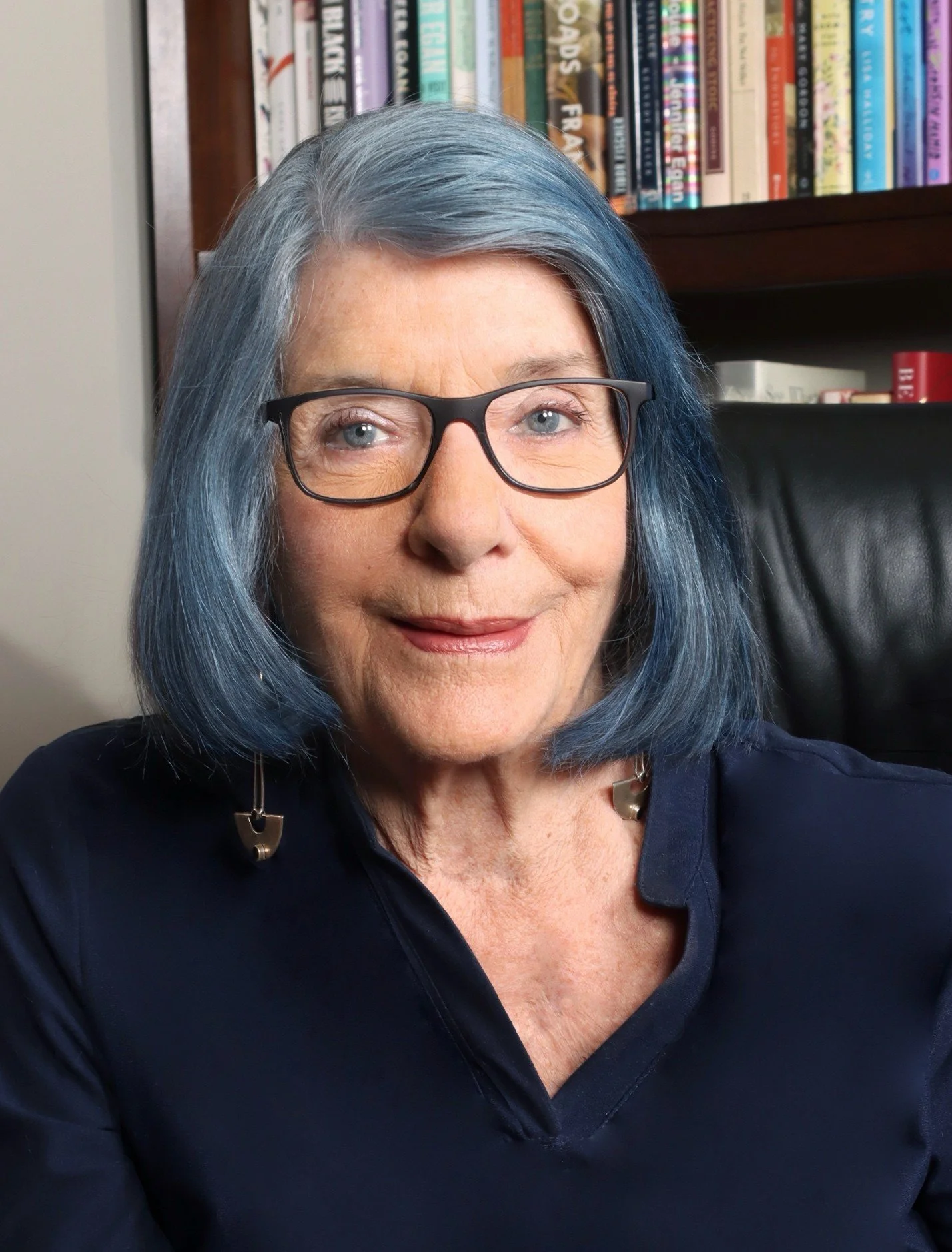
Janet Burroway (Class of 1958, University of Cambridge) is the author of poems, plays, essays, children’s books, and nine novels including The Buzzards, Raw Silk, Opening Nights, Cutting Stone (all Notable Books of NYTBR) and the new Simone in Pieces. Her Writing Fiction is now in its tenth edition and Imaginative Writing in its fifth. She is Robert O. Lawton Distinguished Professor Emerita at the Florida State University and winner of the Florida Humanities Lifetime Achievement Award.