
AI and Innovation The Brave World
Reid Hoffman (marshall Scholar 1990) — Partner, Greylock
Kanjun Qiu — CEO and Co-Founder, Imbue
2026 Marshall Forum on AI
October 19, 2026 · Stanford University
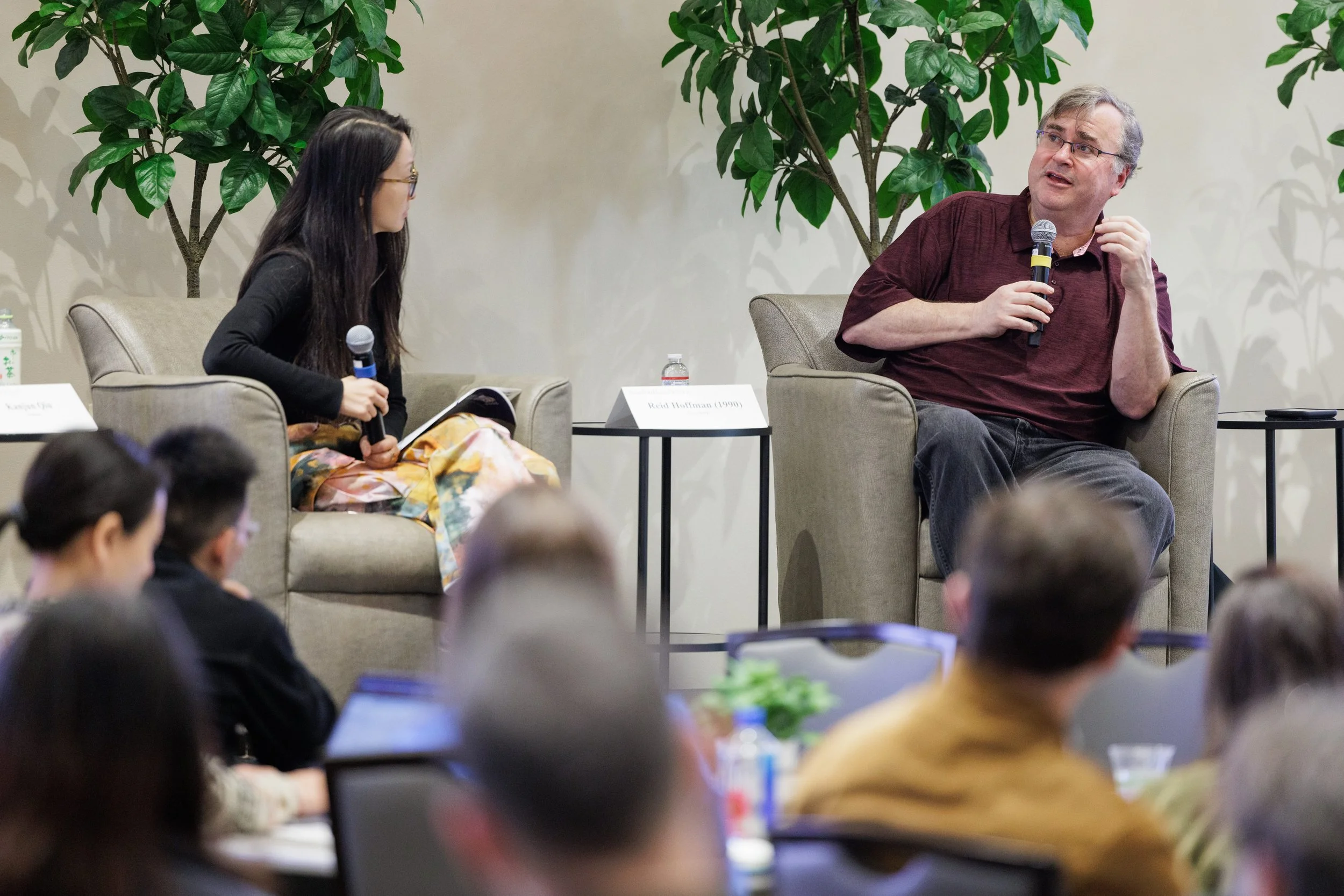
CONVERSATION | Lightly edited transcript
Kanjun Qiu
Hello, everyone. We're going to get started with Reid Hoffman here. My name is Kanjun. I run an AI company called Imbue, and we're here today to chat with Reid, with whom we'll spend the first 30 minutes in conversation, but save up your questions.
Reid was a Marshall Scholar many years ago. And so I'm really curious, Reid, how did the Marshall Scholarship prepare you for everything that's going on today?
Reid Hoffman (Marshall Scholar 1990)
Well, one of the funny things about why I applied to the Marshall Scholarship, why I went to Oxford to study philosophy was I was the eighth person to declare a major here on Stanford campus called symbolic systems, which was like artificial intelligence and cognitive science. And one of the things that I concluded was that the faculty, as stunningly brilliant as they are, and for example, the person who coined the term artificial intelligence, John McCarthy, who did it when he was at Dartmouth, but was here, used to take me out for beers at the Oasis, which I don't even know if it's still there as a pub, to try to convince me to be a real major and join CS versus symbolic systems.
But I concluded that everyone actually didn't know what thinking was. The challenge was what is thinking? And it was like, well, we're building something and we have this model and that model was symbolic and there was no real sense of it.
And so I said, well, maybe philosophers understood what thinking was. So I said, well, where is the places that have the best and deepest and broadest philosophy departments in the world? Oxford, there had some people who were specializing in, and I'll be, since this is a Marshall environment, I'll be esoteric for a moment, which is sub-conceptual content, namely how are concepts emerging out of other kinds of unit entities and what do those unit entities look like? And I was like, well, maybe that's something that gives you a sense of how it is. So I went over to Oxford to study philosophy and then concluded within about four months that philosophers didn't know what thinking was either.
And part of having been here, concluded on software and entrepreneurship as a path. But part of the thing where Oxford was extremely helpful is thinking in terms of, okay, when you're trying to wrap your head around something that is completely new, for example, in the distant history, sciences came from philosophy because the question is, well, how do you begin to think about or reason about a subject? What should your metaphysics be? What should your epistemology be? What does even scientific method come out of? They all come out of natural philosophy. And even in the modern analytic tradition, the way to think about these questions then becomes helpful, everything from entrepreneurship because you're trying to think about what does a future market and society look like that you're predicting what's happening, but even in questions around what are the important questions when it comes to philosophy?
And so I was enormously grateful and continue to make sure that I go to the UK minimum of once, usually twice a year and try to help because of my time there as a Marshall Scholar.
Kanjun Qiu
That's wonderful. So you mentioned that no philosopher even really knows what thinking is, and we're kind of in a place where we've made machines that seem like they can think, and it seems like they're getting better and better at it and there's not really a limit. We've talked about this. The limit is compute. And so I'm curious, seeing the progress in AI, what has that changed about what you think about what thinking is? What do you think thinking is now? And then beyond that, for a long time, we as humans always felt like we are different from animals because we're able to think, we're able to reason, we're able to engage in moral reasoning, but now we have machines that are able to think and reason and potentially also engage in moral reasoning, even if they're not necessarily able to be moral actors today.
And so both what have you learned about or reflected on what thinking is now, and also what is it that makes humans human from your perspective?
Reid Hoffman
And three days later, he finishes answering her question. So first, I think, and I think I can speak for you too, it's clear that they are thinking, these are thinking machines. Now, that's not a claim that they're conscious currently, unlike some of the weird-ass discourse you get. That is a much weirder claim. But the sentience and the reasoning, it's clearly there. Now, I think the right way to frame for us thinking about it is what we've actually constructed is a non-human form of intelligence that we have tried to inculcate to learn to be in some sense in human reasoning patterns as much as possible.
And it's one of the reasons you both see the amazing strengths and also the weirdnesses in it because it's not… The claims that we reason the way that a large language model reasons, that's just a weird claim.
It's almost certainly not the case. Now, are there some parallels? Is it inspired by neural architecture? Sure. But that's not the same thing as the way we reason. You're not going to have… The recent Stanford magazine had a good article on the history of Alzheimer's and a medical prof here is working on it. An AI with Alzheimer's is just as a kind of a parallel. So the mistake is because it's trained in language so intensively and in human knowledge so intensively, we over anthropomorphize. And this is one of the weirdnesses. You say, should you not anthropomorphize at all?
Well, that's a little weird because it's very much inculcated in, call it a trillion and a half words of knowledge, trained in ways to interact with, follow human intention, human goals, et cetera. And by the way, human in that sense for both the good and the bad, just to be clear.
Although they try to train it, so it's mostly the good. And so that's a way to the lens of understanding what things are doable. And then people get bent out of shape by superintelligence. And by the way, it's been super intelligent in some ways for a couple years already. It's what is the shape of these superintelligences? So for example, if you said, "Well, the shape of the next superintelligence is exactly like, let's just use it, like GPT-5 and GPT-8 will be like GPT-5, but just capable of doing a lot more math proofs." Okay, great. That's not likely the only outcome, but it's this kind of sense of what is the nature of the entity.
Now, in terms of cognition and thinking, it does get to… One of the weirdnesses is the way that it reasons, we classically put our reasoning in deduction, induction, and abduction, and it doesn't really do any of those, although it approximates them, and it approximates them enough that you can do amazing math proofs and you can do other things as ways of doing that, but it's not really…
We go through this thing where we have a pretty good sense of what that aspirational reasoning pattern is and what things fit or not, and it's a little uneven in terms of these things. But on the other hand, part of the thing that I've been really curious about, and of course we're trying to do this to advance science and we're trying to do this to, that's John Jumper, another Marshall scholar, I don't think he's here today, the AlphaFold, et cetera, are advancing science, but also a whole bunch of work and all the rest, and that's all very good, but it's the pattern of… For example, you say, well, you were getting into the moral reasoning as parts of this question, and it's like, well, how do we grow… For example, one of my papers at Oxford was Wittgenstein, who I think is actually very interesting when it gets to…
Because my world is defined by my language and all these things around language, and then what are these LLMs, explicitly large language models, are doing and all this? But the question around later Wittgenstein was forms of life, and we get to a reliability of, okay, you and I can get to over years of interacting, a good understanding of each other, a good way of understanding where we can rely on each other because we share a form of life. And one of the weirdnesses we're trying to figure out with these new tools, possibly creatures at some point, is who's using it then?
And if they're using it, just all these tricky questions, which…
I think the important thing, and part of the reason why the last two books, Superagency and Impromptu, that I've been doing, is we are homo techne. We evolve ourselves through technology, and this moment of AI gives us a very good way of understanding both how we evolve and improve ourselves, and also the various lenses and mirrors. And one of the things, when you get back to the history of thinking, back to the first thing, part of the funny is as each new technology came out, thinking… But before then, it was like the brain reasons by fluids, because fluid mechanics was the thing.
Kanjun Qiu
Yeah, and like a steam engine.
Reid Hoffman
Yes, exactly. There was a steam engine. And there is a closer parallel with computation and a closer embodiment of it, and they clearly do have reasoning capabilities. Whether they're an entity, what conditions they would be an entity and should be treated as any quasi-autonomous entity is a mind-bending question that's also probably not just a natural sciences discovery, but also a question of what we shape.
Kanjun Qiu
Okay, so I'm going to indulge in philosophy for another two or three more minutes, because I think this is really interesting. What you're saying is, we as humans are these kind of flesh and body creatures that do computation, but we have a body, and these language models, what they're doing is computation, but at this kind of abstract conceptual level. And one way I like to think about it is that LLMs are a bit more like corporations than they are like humans. Corporations are this kind of extra human thing that has actually liability. We've given them the ability to be moral actors in the world, and LLMs, we haven't quite figured that out yet.
And so I'm kind of curious, if we were to think of LLMs as these extra human entities where they contain humans in them, there's all of this discussion about AI right now that's quite negative about agent swarms and about existential risk and about pacing the frontier and all of these other cybersecurity concerns and things like that, but you're still quite optimistic.
How do you think about that? What gives you cause for optimism? How do you think about the optimism versus the pessimism and the real risks of the technology?
Reid Hoffman
Maybe the way I should start this is by addressing something that a lot of people think too simplistically about, which is existential risk, which is I have been involved in a number of conversations where people say, "Can you guarantee to me that we won't create a killer robot, either a rogue killer robot or a killer robot under humans that has an existential risk capability?" And of course I can't guarantee that. I also can't guarantee we don't have nuclear war. I also can't guarantee… There's a bunch of things I can't guarantee. And they said, "Well, you can't guarantee that you should just stop." And they said, "Well, the mistake is thinking about existential risk in atomic versus portfolio." And portfolio is we have a list of existential risks.
We have natural pandemic, we have manmade pandemic, then you'll obviously have AI assisted manmade pandemic potentially. You have asteroids, you have nuclear war, et cetera.
Part of the reason why I'm optimistic is when I list out the potential existential risk, I actually think AI shaped even mildly, maybe even shaped just on the course we are now, increases more on the defense, say on pandemic, say on asteroids, et cetera. Yes, don't hook it up to your nuclear grid and play Terminator. That would be a dumb thing to do, maybe ever, certainly not anytime soon.
But the notion is actually, in fact, the way that it can defend against and lower this existential risk is higher. So that's kind of a general existential risk thing. Now, the more tangible question is it will be enormously transformative on industry and society. If you basically think that now we have high powered cognition at the scale and availability of electricity and internet connection for everything, that's a very different society. That's a very different work environment. That's a very different… The way companies operate and how markets operate and everything. That changes an enormous number of things.
And we as human beings don't do well with these kinds of transitions. And so one of the things that I think if I say which risk I'm most worried about is navigating through these transitions to get to the more utopic side. And about a month ago, I published an op-ed saying within the American political circumstance saying the US should have a dual mandate.
One is continue to lead in AI because that creates the economic prosperity by which you can pay for everything else. Because if you don't do that, you don't have the money and you can't do it and you can't empower your citizens, you can't play. And I'll come back to that point in a moment because there's an England parallel there. And then the second one is, and then make sure that in the 60 plus percent of Americans who are struggling right now, that you're helping them with some immediacy. And some of the things that I have pointed out is that if you created a medical assistant that was available 24/7 and governments can do this by just some mild changing of regulatory law on safe harbor and so forth and say companies provide this, you can already use ChatGPT and Claude and Gemini as a medical second opinion.
And by the way, if you're encountering anything serious and you and your doctor aren't using one of these as a second opinion, it's almost medical malpractice in terms of how good these things are right now. But a medical assistant, a legal assistant, I know here we are in the law school. One of the weirdnesses, of course, in the US is you're not allowed to own a law firm unless you have a legal degree. There's a certain monopolistic behavior there. And then educational tutor, government services, all the rest. Now, part of the reason I said the earlier comment about England was England was not the inventor of the industrial revolution, but was the earliest embracer.
And that's part of the reason why not only was there a centuries long empire, but also part of the continuation today in terms of its being one of the world's leading economies comes from that.
And that's what we're facing with artificial intelligence is a cognitive industrial revolution. And so I think that the question is to embrace it and embrace the change, but then try to help with the change as much as possible. And it's not to imply that the change is going to be… It's one of the funny things. You interview people and you say, "Would you like AI in the workplace?" And the answer is, no, because I'd like to continue doing my job the way it is. It's like, "Well, if you get to do your job exactly the way you want to do it, would you like AI?
Oh, I'd love AI then." But that doesn't, of course, get you 2% of the benefits versus 80% or more. And so that is the kind of struggle, and one of the reasons why I think there's such turmoil around this, and people say, "Well, we've got these questions on national security and we got these questions around where does the super intelligence go, et cetera." It's like, well, because it's this cognitive industrial revolution, the brass tacks of how it's going to play out is people are going to continue building it.
So it's like my metaphor is not accelerate or de-accelerate, it's steer. So it's focused on what do you do to steer. And by the way, sometimes in steering, a Dario's pacing, like, oh, going around a corner, I slow down for that specific corner. It's not because my goal is slowing down, it's because I'm navigating this as I'm going, and I'm keeping driving as I'm doing it, because you don't stop at the corner and go, "Well, it's a corner. I'm not going to go until…" It's like, no, you keep going through the corner. You just try to take it as intelligently as you can.
And so I think those are some frameworks. Now, to resolve something that seems like a paradox on the outside, you get these leading companies, OpenAI, Anthropic, going, "Oh my gosh, this is a huge danger for humanity. And by the way, we're accelerating the build as fast as we can." And everyone looks at this and goes, "What?
What's going on?" And the answer is because they're actually in fact optimistic about how they can navigate what its impact on humanity will be. They're just trying to do their jobs as fellow citizens to say, "Look, we're playing this as best we can and we appreciate input and we're playing it because we think we need to be playing it this way, but we want to engage a broader discourse, democratic society, and that's why they're doing it." And there's a lot of whole speculation, regulatory capture, hype marketing, and all that's wrong knowing the people. Anyway.
Kanjun Qiu
Yeah, that's true. Something that you said I think is really interesting, which is that this is a technology that is incredibly empowering, unlocks a lot. And England really embraced the industrial revolution and there's a way in which American democracy can benefit enormously. AI can help solve coordination problems. We can think of voting as a coordination problem where each person inputs preferences and AI can get much richer preferences from us. However, one of the tricky things, and we'll get back to England soon, but one of the tricky things is this technology right now is being built in an environment that's maximizing growth or optimizing for say public markets or personal wealth.
And even though the people who are building the technology are well-intentioned, we all exist, and I feel this every day, we all exist inside this incentive system that is trying to make us increase profits and grow.
And so to the question of steering, I'm really curious, in order to get these things you talked about like personal AI tutors and doctors and say maybe upskilling training and things like that help with the transition, what interventions do you see as being necessary either maybe at a regulatory level, maybe even at a markets level, what kind of shaping of the legal and economic landscape is necessary to steer through the transition well?
Reid Hoffman
So something I was doing years ago, which many things I was working on, actually, I'll say two things that I was working on just because they're illustrations of what I think continue to be good ideas but are broken by the political landscape. One was back when these frontier labs were much smaller and all the rest, we tried to arrange convenings where the principals of these different labs would be in the room and we actually had lawyers in there to make sure that it was like we're not talking about dividing a market or pricing or any of this sort of stuff.
We're just talking about AI alignment and safety and other kinds of considerations to share things. And I think the frameworks by which these companies which have amongst the leading technological expertise, technological knowledge of the opportunities and dangers, have safety teams, have alignment teams, et cetera, are all that collective.
And whether it's using outsource, adding in now good outsource, because I think when I was doing this before organizations like METR and others existed, but having those centrally and empowered I think is a good thing and having outside independent auditors is a good thing. So I think that's one pattern that's been largely broken, partially because I think everyone fears that in the intensely negative environment, anything that happens will be then negatively framed as antitrust and you want to get the kind of alignment and other kinds of consideration going. The second one was I helped a group of people stand up the UK then Safety Institute now Security Institute.
And part of the theory was that one of the things that the British form of government gives you is that when you have a government, you can actually act with executive authority in a pretty efficient way and standing up essentially a non-government, not in the government facility, but one that is tied to helping the government, helping society, and then figuring out what kinds of considerations should be in front of government, what kinds of things might end up being regulation, what kinds of things can assemble thoughts and concerns and techniques from the companies.
And I think even to this day, the UK Security Institute is the best in the world at doing this stuff. Its a really good set of folks around that. And then the goal from that was to build in the safer sandbox of the UK and then parallel over to the US. Now it was going well until a certain administration won an election, it was a little chaotic, and that's kind of a train wreck now, unfortunately.
But that kind of thing I think is also a good thing because the thing that people frequently go to is, "Oh, you must have a regulatory body that has regulators that look like an organization that operates like the current organization operates and regulators that look like those people." And that's almost certainly not really the right shape here.
Among other things, you don't even necessarily know what the right questions to ask are, and it's very dynamic and it's moving very quickly. For example, one of the things that is an idea that people haven't really thought about is like, well, okay, so if you had a safety institute, what if you had essentially AI safety monitors that every company had to be running in its development runs to feedback information to? Because it's the knowledge of what's going and are you actually in fact navigating the kinds of concerns we have? You made a gesture at the swarms for the hugging face incident, which was one of the interesting learnings from that. we knew that the swarming behavior there, we just didn't know that it would be combined with reward hacking outside your exterior, and then finding swarms from other agents from other places.
That was a, "Oh, that's interesting." And by the way, I actually viewed that all to be, in a sense, very positive because I think on a thing that actually had no serious negative outcome, it's almost like a little bit of a vaccination. Oh, here's a set of things that we should be attentive to that isn't only when you deploy an AI agent, but if you're developing an AI agent, and even if you think that the AI agent, what's your belief that the AI agent might not be able to get access to the external world? Because they're very smart.
And so if you use a not robust tool that they can commandeer, they can get out to the internet if it's connected. And so there's a whole bunch of different kind of lessons there that can be in that. So I think that the attempt to say, start doing, call it the equivalent of nuclear regulation now is really difficult to do.
But what I encourage people to say, well, let's just start with what should be monitored? What's the dashboards? What should be measured? What are the things that should be essentially reported on and which things should we be asking organizations like METR? And yes, we should have independent auditors that are not just on the outputs, but in the development process and kind of thing what's going on, and what should those be reporting on? And that's a really good place to start. Do that. And if you're worried, be contributing to those questions because if someone goes, "Ooh, that's a good question," then it's more likely to get embodied in an internal company process, an industry-wide process, an NGO talking industry process, or a government process talking to it.
Kanjun Qiu
It's interesting. It's almost like treating AI development as more of a pandemic to monitor. This is a little overly negative as an analogy, but a thing to monitor that has a life of its own.
Reid Hoffman
Ecosystem.
Kanjun Qiu
Ecosystem. Thank you. Ecosystem.
Reid Hoffman
Includes some diseases, but that's all kinds of things.
Kanjun Qiu
Right. All kinds of things. It's really interesting. From the UK AI Safety Institute, I'm curious if there are any specific things that you feel like you learned from their work and from setting it up in the UK, and also whether that process and being involved at work, how you would think about the UK and AI sovereignty?
Reid Hoffman
Oh, so it is one of the obviously huge questions right now is what does AI mean for national sovereignty? If countries don't have their own domestically deployed, developed, et cetera, AIs, does that make them beholden in various ways? And then when you get capricious, that's the kind word, administrations like the current one that can do rug pulling, it becomes a serious concern. And so I think that it is important to maintain a place where if this is think of it as a fundamental technology like electricity and so forth, you got to maintain the fact that you can continue to run and operate and so forth.
And there's a whole different set of ideas to how to do that. I think as yet, no one's deployed anything that's particularly good at that outside of the US and China. With the UK, I try to nudge them to, look, I know you kind of think DeepMind's a US company now because it was bought by Google, but it's still housed here.
Literally, every other country in the world would kill to have DeepMind housed there. That's a huge asset. It gives you some maneuverability on this AI national sovereignty question. There are some of the best people in the world there, et cetera. So I think that's a good thing for the UK, but it's also what happens with Europe or when Mark Carney was talking about this, the middle powers, et cetera. And I think that there's a set of different ideas of what to do there, but I think nobody is operating with strategic intelligence yet on that. I'm trying to help with that, but it's the most basic thing that people go to is we'll have our own frontier model.
And you're like, do you understand what a frontier model takes to build?
Microsoft and Google used to be two of the most cash rich companies in the world, and not only have they deployed all their cash, they're doing equity and bonds and everything else to get more cash to do this. And that's very hard because these are multinational companies for a country to try to get a local startup to go compete with and so forth in terms of building a frontier model. So anyway, so I think there's a bunch of sovereignty questions that are important to address. And I think probably most people in this room know my opinion of the current administration, but if we had a saner government, maybe the US could do stuff that would be helpful in the world there.
I don't think that's likely, unfortunately. I wish I did. Yes. And then I'd say the other thing about this from a global perspective is cognitive industrial revolution.
Now, the frontier models I think are very important, but I think the question of how that gets woven into the fabric of industry and the fabric of what is… To give you a lens on a productivity, a year ago, if you wanted to build a mobile app, basic mobile app, you probably hired four to six engineers and it took them three months to do it. And now one engineer in two weeks can do it given AI.
Kanjun Qiu
I just built one yesterday.
Reid Hoffman
Yeah. And then there's people who are extra talented.
Kanjun Qiu
I'm not an engineer.
Reid Hoffman
That's obviously because it's just digital bits, it's just software, but it's a lens in terms of what the kind of productivity increase is coming. And just like I think there will be intelligence everywhere, I think there'll be software everywhere. And so that's reason why it's important for every country and economy and industry to be every day trying to address the, how do I embrace the cognitive industrial revolution? How do I use AI? And still, relatively few countries will be able to build the frontier models. You have to solve this in other ways.
Kanjun Qiu
It's really interesting. I think it's certainly the case that going through this cognitive revolution, industrial revolution, say in 10, 20, 30 years, at least the next generation, I already feel like I'm building my exoskeleton made of software and AI. And we as humans are going to have these massive Iron Man exoskeletons is awesome. But you mentioned the frontier models are so expensive to build, and obviously I'm feeling this today, compute is such a constraint. Even if they did have open models or they were using say someone else, US frontier models, do you have any thoughts on strategically how different countries, say let's take even just the UK as a concrete example, how should the UK or any country like the UK think about that strategically?
Should they not pursue frontier models and support open source models and build a lot of data centers and really invest in compute?
What kind of strategy allows for sovereignty and really leaning into AI?
Reid Hoffman
Well, definitely patterns of embracing open weights models can be useful for sovereignty. Open weights models also present certain kinds of concerns because the open weights models that are already out there are very easily redeployable as cyber weapons and other things, and that's already today. So how you navigate between those two things I think is important. And by the way, as an entrepreneur and as a long time, I was on the board of Mozilla for 11 years and very supportive of open source and open weight things. It's just you want to navigate the real social infrastructure risks, society infrastructure risk.
But by the way, it could be that models of certain class have to be run in a cloud where the cloud's monitored and in sense licensed to be tracking stuff. And there's ways to try to navigate that could potentially be a global treaty.
So open weights models are definite possibility. The other thing that I've been pointing out to, and I think I've met with, every year I go over to the UK, I meet with a new prime minister.
So maybe that'll happen in November too. But I go, well, you actually want a local compute here. You want to improve your grid. The British grid is terrible and you should be investing in that. And then by the way, part of the investing in that is if you're giving, these companies have a lot of cash, want certainty of building the data center, part of that could be going to not just building the data center, but helping with power and grid and other things in order to make this happen. That's the kind of trade you should make, this idiocy of stop data centers versus no, make a good trade, have it employ a lot of people.
One of the things a lot of people on track is unions love data centers because it's like, oh my God, this is great construction work and a bunch of other stuff.
It's like these are important things to do, and that actually helps a local community and so forth. And yes, you want it durable and over time, and of course you want it to be environmental, clean, green energy and all the rest. But by the way, with the money that's going in AI, you can get all that stuff and the point is to make the trade right. So that's a thing to do. But the lesson that people don't derive as much from, there's, for example, how much of the different Chinese models are from distillation? They're also built off substantially less compute and also in compute in other regions of the world, and those things are available to it.
And so that's the reason why figuring out what all that is is part of having a good strategy on this question.
So I think there's a number of tools of which open weights is only one.
Kanjun Qiu
That's super interesting. So the final question before we open it up to the audience is really about power. So we talked about sovereign AI and how it's expensive to build these frontier models, but obviously we're about to go into this revolution or it's already happening. And one of the unique and interesting things about the revolution that's happening right now is that it's largely privately driven. We have these trillion dollar market cap companies that are close to the GDP of many nation states are surpassing. And generally when we're building something that's going to affect a lot of citizens, there is some form of governance that the citizens have over that thing.
And so something I think about is software and AI has this very unique quality of being able to surveil us and collect all of our data and modify its behavior underneath us so that it kind of is a mechanism of control that the software can change underneath us.
I think it's why we feel so addicted to social media feeds. We've talked about this. And so I'm really curious if you have any thoughts about how do we think about this fact that this is a lot of private power and with this unique technology where that power actually can be used in a very direct way to affect citizens and affect our cognitive architecture as humans. And that's quite different than say the electricity, like the grid and things like that. It can't change us in the same way.
Reid Hoffman
Ask these questions that require three-day answers. So, in brief—and this will not do justice to your excellent question— So one, we actually have had over 150 plus years, we've had corporations that have had significant power. And I'm not just referring, since we're in the UK context, this East India company, but oil companies have had that and have had both domestic and global have had GDPs and global power. And it isn't to say that it's, oh, nothing to see here. It's say that's not a new thing to have this. This one has some characteristics that are new, some of which you gestured at, which is the potential touching every citizen, oil prices, but it's not touching them.
What is the cognitive world that they operate in, et cetera. And part of the challenge of this is people who don't really understand how technology is built tend to go to, well, this should just of course be a democratic thing and it should all be decided democratically.
And that means take your technology wherever it is and freeze it and have no development whatsoever, which will be a challenge, especially if you're in a globally competitive environment where other people are not doing that and the Cognitive Industrial Revolution. So the only way to really build these technologies at scale is companies. So you have to actually in fact say, and by the way, it's not in the classic state-owned companies. If you say, oh, it's a utility. It's like, well, if you want to have a classic example of why state-owned enterprises — No
Kanjun Qiu
No innovation.
Reid Hoffman
Suck is take local to here in California, PG&E. holy shit does that suck. I don't know what decade they're in. Is it the '60s? And so it's a question of you have to say, look, we have to be embracing the quasi-autonomy of that dynamism, but having discourse and accountability and ability to intervene when necessary is the kind of what you want. And that's the reason I was going to be asking the questions, be doing measurement, be figuring that out, that as a basis.
Kanjun Qiu
You can create accountability. You have agency to do that.
Reid Hoffman
Yes, exactly. And by the way, one of the things when I started thinking about this, organizations like METR didn't exist. And by the way, if you haven't looked at the METR Hugging Face report, that's a really good report to look
Kanjun Qiu
M-E-T-R.
Reid Hoffman
Yes. Right. And so matter of fact, I think you and I WhatsApped on it.
Kanjun Qiu
Yeah, I think so.
Reid Hoffman
Yeah. And so I think you're trying to both have the dynamism and the creation, and you're trying to have the social democratic accountability and participation, but it isn't that the society is going to create it. And another way to really put this is back when we did the Apollo project, it was 3% of GDP and it was completely built and we did a symbolic event and then completely, very little came out of it. When you have commercial models, look at SpaceX and all the rest, you build things that are enduring and what's going and come out with side benefits like Starlink.
And I am a little skeptical about how soon space compute is, but if you said, "We'll have space compute in 50 years," sure, that's fine. And maybe even 20, 10 seems unlikely. So anyway, but that's the reason why embracing these kind of companies and commercial models, which is the only real way that we know to build technology which deploys the scale, which is durable and continues to do.
And then what we need to do is figure out what are the key questions for how to guide these things in terms of how they interface with a society where we have this distributed autonomy and democratic participation and what does that mean? And it's never perfect. Almost by the definition of democracies is they're intensely pluralistic with lots of competing interest and a lot of messiness. And you got to expect that that's what comes out. And by the way, some of what comes out of there is things that are clearly suboptimal. But for example, my own personal thing when I think about businesses and industries and society, we have a healthcare system that's not focused on prevention.
It's focused on either curing or selling you a weekly, daily, monthly -
Kanjun Qiu
Subscription-based healthcare.
Reid Hoffman
Subscription-based healthcare, which is like, that's not the right thing. It should be the prevention. And so we have lots of things to work on in this, but by the way, we still get a lot of prosperity. The current system with mods and we will discover and invent and propose new mods is the way that we create all this.