Preserving Learning in the Age of AI
Julia Rafal-Baer (Marshall Scholar 2006) — Co-Founder and CEO, ILO Group
Julie Mikuta — Co-President, Education, Charles and Lynn Schusterman Family Philanthropies; Executive Vice President for Post-Secondary Education and Training, RAISE.US
Jack Goodman (Marshall Scholar 1989) — Founder, Studiosity
2026 Marshall Forum on AI
October 19, 2026 · Stanford University
CONVERSATION | Lightly edited transcript
Jack Goodman (Marshall Scholar 1989)
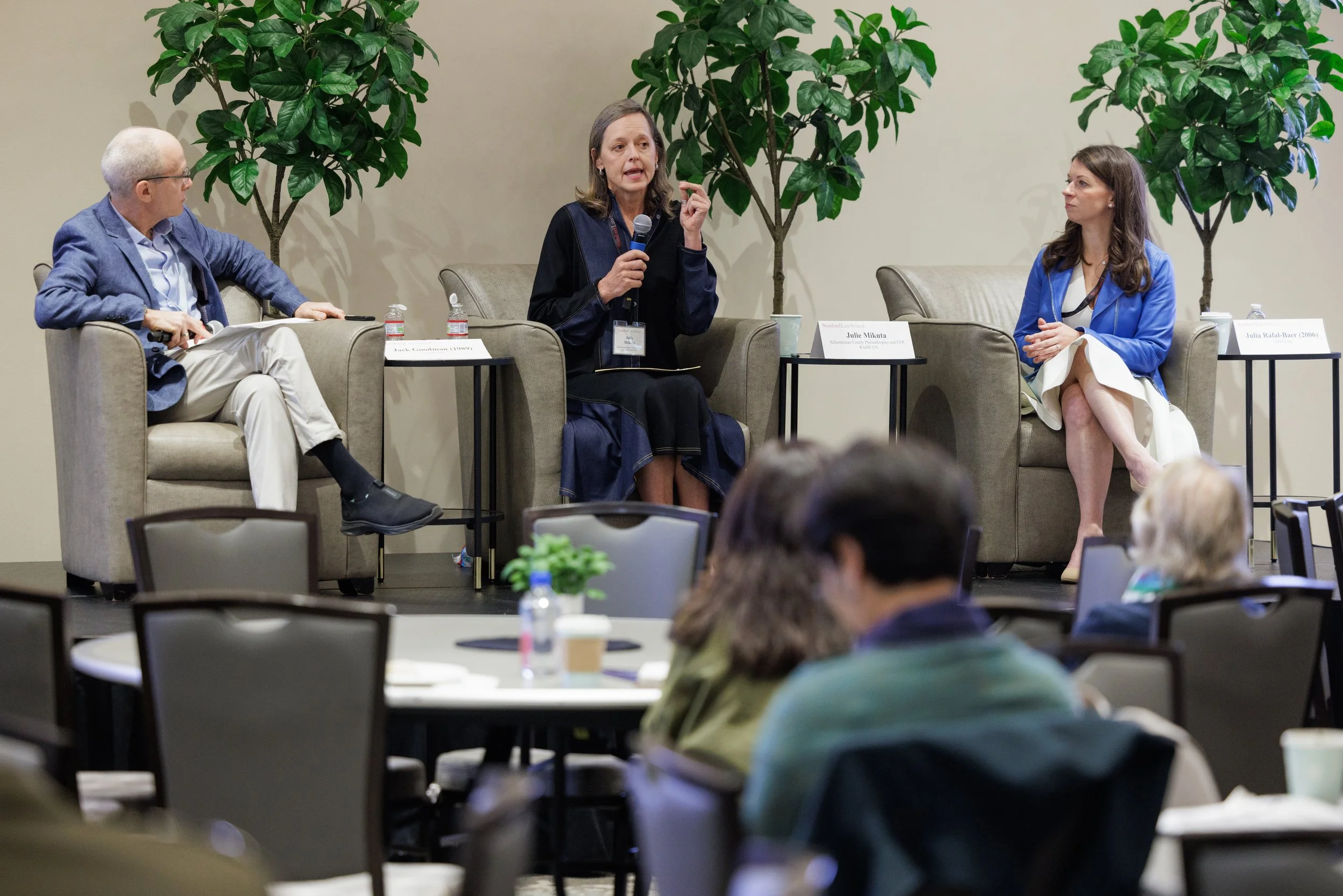
Welcome everybody. Welcome to the second day of the Marshall Forum on AI. My name is Jack Goodman, and I want to acknowledge Stanford Law School and the Association of Marshall Scholars for co-hosting this event.
We've titled this discussion “Preserving Learning in the Age of AI.” So I'm going to make just a few comments to get started and then we'll hand it over to our esteemed panelists who know far more about this than I do. But I think as most of the people in the room would probably be aware that the world of education is drastically different for today's young people than it was for us. If you've got children, who've been through or are currently in formal education, you know it's really a brave new world. Teaching and learning environment in the US, UK, and the country I've lived most of my adult life in Australia has been, for the last three decades, it's been intermediated by digital technologies, student information and learning management systems, Wi-Fi, one-to-one laptops, smartphones, tablets, apps to encourage inquiry, collaboration, connection, research, and curiosity.
And for the last four years, accelerating generative artificial intelligence in the form of omniscient or increasingly omniscient, let's say, hyperlinguistic chatbots that have an answer to every question. Yet now as we look at the data and the evidence gathered over decades, it appears that more tech more widely deployed has crowded out many of the things that matter most for human learning and replaced them with what many have called some weapons of mass distraction. Indeed, when generative AI was most rapidly embraced by high school and university students when it was first released, when they discovered its capacity to output coherent text that was often difficult to identify as machine created, and researchers over the last three and a half years have identified concerns about first cognitive offloading and cognitive atrophy, and most recently cognitive surrender, which refers to the phenomenon whereby students perform better while they're using AI and then once that access is removed, they're actually worse than if they'd never used it before.
And so the most recent piece of data, that's an international global assessment of education attainment data, and it's repeated locally here and in Australia, shows that other than a handful of Asian countries, most of the rest of the OECD is on a downward trajectory in terms of learning achievements for our school students across math, science, and most importantly and radically literacy. So we're facing some really confronting trends, which is why we are so fortunate to have these two incredibly capable and knowledgeable women on this panel. So I'm not going to try and introduce, I'm going to let them… We've got Julie and Julia, which reminds me of a movie some of you may have seen, which is lovely.
I'll let you introduce yourselves and a little bit about your backgrounds. Why don't you start first, Julie?
Julie Mikuta
Good morning, everybody. Julie Mikuta, nice to be here with you all. I have two hats on today actually. I am co-president of Charles and Lynn Schusterman Family Philanthropies overseeing our education work, K-12 and into post-secondary. We focus specifically on literacy in large urban districts with a focus on low income kids of color and making sure that they can exceed all expectations and achieve at the highest levels. And then also more recently joined Gina Raimondo, former secretary of commerce, as EVP for a pillar of what she's building out, which is an organization that is designed to help the American workers succeed and thrive through the AI disruption to the labor market.
And in that role, I oversee all of the work around post-secondary programs, which are both two- and four-year organizations as well as any other types of training organizations. And I hail mostly from education, everything from being elected to the Washington DC School Board, which was, wow, a lot, to being a founding teacher of charter schools, helping to launch schools, doing some policy work and senior leadership of various nonprofits.
Julia Rafal-Baer (Marshall Scholar 2006)
Good morning. I'm Julia Rafal-Baer. I'm the co-founder and CEO of ILO Group, which stands for In the Life Of. We work with governors, state leaders, and district leaders across the country. I'm also the founder of Women Leading Ed, which is the largest national nonprofit network for women in education leadership. My career has spanned classroom teacher all the way up to working at the top levels of government in New York State. I've worked in policy roles, I've worked in philanthropy roles, and I spend most of my time now on leadership development efforts, how we really train next generation leaders to really understand what it really takes to be as effective as possible and to sustain for as long as possible in top leadership roles.
I also sit on the National Assessment Governing Board, which oversees the NAEP assessment, which we're going to get into a little bit today.
It is the assessment that gives us a sense about what's happening in our states across the country in grades four, eight, English language arts, math, science, social studies, essentially our temperature check about how our country's doing in terms of education efforts.
Jack Goodman
I'm glad you did that because it was far better than I would've done. All right, well look, let's just get into it. Given the rate at which AI is moving and the fact that the opening move of the big labs was to give away "free access" to tens of millions of early adopter students and all of us, is there the equivalent of an asymmetric warfare situation right now for schools and districts and states and universities? Are our institutions capable of responding in strategic ways to a landscape that's shifting monthly, if not weekly? I don't know.
Julia Rafal-Baer
I do think this question of the speed at which things are moving is a really tough one. Right now, the biggest gap I see is between an understanding of what's actually being used across systems and then whether or not what's being used is effective. We've taken to seeing this as an assurance problem. States and school districts have a responsibility to assure that the public understands what kinds of tools are being used, whether those tools are effective, and if they're not, how those tools will stop being used. In the state of Delaware, they're building the first of its kind, it's called an assurance laboratory.
They essentially went out and created a survey to understand what tools were being used across their school districts. Voluntary survey, their districts and their charters answered that survey because they too wanted to know what everyone else was using.
Now the state's working on testing models before they'll be approved, and then they're running cycles to test the claims of what those models said they would do. So if you're saying that you're giving back time to teachers, if you say that this is going to improve student outcomes, is it working under what conditions? And we've been learning a lot from it. There's plenty of tools out there that can produce beautiful looking results, but those beautiful results are completely misaligned with what a state requires. We saw this with a wildly popular tool for special education. It's supposed to help to create these individualized education plans that guide student learning.
But when you actually test the model against state requirements, complete mismatch, completely failed. Now, the goal isn't then that you say you're not going to use the tool, the goal is that you help work with those providers and that they should change what they're doing to get into alignment.
So I do think it's possible, Jack, that we can get to a place where states and districts can have that kind of oversight, but the gap right now between where people are in their training and ability to get this off the ground is quite wide from the reality of how fast things are moving.
Julie Mikuta
I'll just pick up on the speed pace because right now what we're seeing is teachers are certainly using these tools across the school system. For example, approximately 75% of teachers on an annual basis, they're using ChatGPT or some other type of chatbot. Then there is a program called MagicSchool where teachers can use this resource to help to plan lessons and analyze what students are doing. And 40% of teachers, 40% of public school teachers are using this resource. So to me, the question is how do systems adapt? Because the systems that these tools are being embedded in are just too stuck.
They do not change well. There's not a path to change. So the work that Julia is leading is absolutely essential because as a parent and as a former teacher, This is the most powerful technology of our generation and potentially ever.
We don't want unfettered access for children. We want to see good, strong policies and guardrails around the use of these tools. And at the same time, we don't want young people, especially kids in low-income communities to graduate AI illiterate because both are a betrayal of the future of our country. We need folks who deeply understand what are these tools and how do we best use them in different contexts? And so this is going to take a lot of work around figuring out, in addition to the work that Julia's doing from the top, what does that look like for the implementers, the teachers?
How do teachers suddenly with this new technology understand how to teach their kids to use it well and how is it embedded in ways that teachers can then improve their teaching well? And we're seeing some institutions, especially in the higher ed space, change pretty quickly.
There's quite a few institutions going for three-year degrees, even places like Georgetown, because folks are understanding that over the course of a person's lifetime, individuals are going to need to move in and out of the education system in a way that when we got to our jobs, we didn't necessarily need to do. And so what does that look like for learning to be flexible, adaptable, connected to careers and affordable, especially for folks who are in and out of these training programs through their lives? And so I think the speed piece is very important, but it hits an infrastructure that is very stagnant and that's what needs to be shifted is how do these systems move more quickly?
Jack Goodman
I thought I might just dig into that a little bit more, actually. It's very interesting what you both said. I don't know that there's a lot of dispute or controversy about providing any of this tech to the educators, to the adults. I think the real concern a lot of people have is when kids have their hands on it, and obviously they can use this stuff, we all are getting it pushed to our mobile phones and it's all publicly, it's been freely available since November 22nd, 2022. But I just wonder, maybe you could start here, Julia, is some of the things you were saying made me want to ask this question.
Should we require or insist that there be some evidence base for tools before they're deployed in schools and not ask the schools to try and figure out if something is working or not? Would it make more sense to have a tool that actually has had some research or it's been co-designed with educators?
I'm curious to know what you both think.
Julia Rafal-Baer
I think there's a couple parts to that. First, I think we are building the evidence base and we're learning in real time all the time. I think for me, it gets to this question about assurance. What are the ways in which you're setting up governance structures in school districts and in states to make sure that you don't end up with shadow governance where tools are being used because nobody has sanctioned them and there's no oversight. And so then you don't even know what's happening within your schools. Getting to a place where you do have a sense about what tools are being used and you set up front what the expectations are on whether or not those tools are going to be deemed successful.
And then if they're not, what's the plan to stop them? What we see over and over again is what I've started to call the triple veto.
By and large, the easiest move last school year that states and districts were making was setting up task forces, committees, and developing guidance documents. And then people started moving to the, I refer to as say yes pilot. It seemed easy enough to say you were going to pilot in one or two classrooms or schools, but then someone has to make a decision. But those committees lend themselves to having your legal department, your IT department or your academics, somebody saying no at all times to whether or not something should scale. By setting out upfront what you're expecting the tool to do and being able to continuously look at whether or not that's doing it gives you a concrete way to answer to your board, to your constituents, to your parents, why this tool is going to continue to be used and under what circumstances, but also to show people why you're going to stop using a tool.
This school year, we are seeing a huge shift for the states and districts in our cohorts where the focus is all about students. Last school year was about the adults. It was about getting systems in place. This school year is so much more because there's so much more pressure where parents want to know why is this being used? Where is there evidence? I think that's just going to continue to be a trend for this year.
Julie Mikuta
In philanthropy, there's a group of about a dozen large national funders who have come together to try to understand how to build the infrastructure upon which tools are developed to make sure that they're most likely to be efficacious for kids. So for example, one of the current projects that these funders are coming together around is recognizing that, of course, the large language models are the key to how the tools interact with young people. And if you're talking about literacy, just think about this. You're a classroom teacher, you've got 30 kids, some of them are… English is not their first language.
And the models that are being used in front of our kids need to understand, is this a child from a particular country who has a particular accent? And when they pronounce a phoneme, which is like a letter sound, if you will, are they pronouncing it right or wrong in the context of a very noisy environment?
And there's no real business case to build that out. And so philanthropy is stepping in to say, let's build out the data sets that are both for benchmarks and for the large language models and then encourage developers to build on top of that and solve other problems so that you're steering the market by influencing the guts upon which the tools are developed so that they're much more likely to be able to be attuned to student needs. And I think that's a really important way to get at this problem about what results in good student learning is to look at what are these tools being built on and how do we shape that infrastructure so that good products follow from the good inputs.
Jack Goodman
Thank you. I want to dig in a little bit to this word of assurance, Julia, that you have mentioned a couple of times. In Australia where I have lived for a quarter of a century, there's a huge amount of talk about assurance in the framework of assurance of learning. How can universities know that the students that they are graduating actually can do the things that the degree, the piece of paper that we historically have relied on means something? The last four years have put pressure on that nexus in a way that no one ever imagined.
Now the sector is in the same sort of situation obviously that it is in the US and the UK, huge amount of pressure. And that sort of leads me to something that you said, Julie, which is around trying to use these tools to develop and augment literacy. I think that is one of the big issues, and I'm so glad we have an expert on…
I thought I would share some data. This is not NAEP data, but it's PISA data, and it just means it's international data. But you can look this all up. This is from 2025. It's the most recent. It's a global OECD exam that's given around the world every three years, I think. And you can sort of see, you don't have to be able to read all that, but you can sort of see the trend lines and the worst trend line is literacy. So what I just wanted to ask both of you is that overall, these trend lines are obviously unambiguous, but literacy skills especially are on a steep downward trend.
And Julie, you shared with me a really interesting Substack called The Fall of the Class of 2023, which documents in excruciating detail the decline in student performance over 15 years, this is in America, in line with the following pieces of evidence, a precipitous drop in reading for pleasure, schools leaning into devices in the classroom, a decline in homework being assigned, and a de-emphasis on state tests.
And actually that's an interesting point because in the UK, I'm trying to draw a connection here to the UK, it's a bit of a struggle, but in the UK actually, they've bucked this trend a little bit, and part of it has been a refocusing on literacy and reading and also on preparing for exams for better or worse, and that has worked for them to some degree. So there's one more piece of data that I'll just mention, which is that every cohort that has come through the fourth grade since 2015 in the United States has scored lower than the last on the NAEP reading.
So please help us understand.
Julia Rafal-Baer
All right, so a couple different points on this. National assessment that I shared, NAEP, that we administer had strikingly similar findings to what we're seeing with PISA, and we recently put out our long-term trend results. It's the longest running assessment in our country. We began giving it back in 1969, and so it gives us a sense about what's happening irrespective of any changes to how we are measuring reading and math. It's just a different type of assessment construct. What we found on this is that 2012 was our peak, and I've been spending a lot of time really thinking about what was going on in those kids' lives in 2012.
What do we know in terms of policymaking? What do we know about what was happening contextually? There's a lot of pieces to it. It's everything from a generation that didn't have TikTok. Instagram wasn't really a thing.
It was a different level of distraction. We also saw some big shifts that were going on in terms of how we were approaching policy. We saw less accountability, less of a focus on holding people to results. And from there, things just really had a backslide. For many parents, they started to observe there was a very different kind of experience. Grades got easier. It's not like our courses and books were getting easier. Things just started to loosen up, and that loosening has had an effect that we're seeing. But what we see on the assessment that's really important is that there is a very big difference between our highest performing students and our lowest performing.
Over and over, what we see on NAEP is that there is less of a dip for our highest performing and our higher wealth students. We also have a number of contextual survey questions that we ask.
We know that we've been consistently having the lowest levels of kids reading for fun, the lowest levels of kids having books in their homes, and some of the lowest levels of kids just frankly saying they have somebody in their life who's asking them about school. I think there's just a lot at this point that we're really starting to understand, particularly about the importance of real books, digging into real literature, helping kids to develop those critical thinking skills through the depth of content knowledge, and being able to really apply that and have strong policy moves. There's a number of governors and state leaders who've really done incredible work around the science of reading about helping people to learn.
And so we do know it's possible, and there's school districts that are really bucking these trends, but it requires a real depth of implementation. And my biggest worry is that we're going to layer on AI tools in places that have not gotten right this implementation chain and are not yet prepared for the kind of rigor that's required around this.
Those that do are going to maximize this in a different way, and that's where I think we'll see some of the unevenness.
Julie Mikuta
Okay, I'll pick up on that. So as I said at the top, Schusterman Foundation, so that part of my head is all about literacy. And to Julia's point, what we're seeing in different places where we've gone deep in school systems is that, have folks heard about the Mississippi miracle, familiar with this? So Mississippi was ranked at the bottom of the states in terms of literacy within a very short time is now up near Massachusetts. Basically, they followed the science of reading implementation, as Julia has said. So that's at a state level, and that's a lot of kids who honestly, a lot of folks had given, oh, Mississippi always going to be at bottom of the rank.
We're seeing other school systems like in Aldine, Texas, where 87% of children receive free or reduced-price lunch and a very high population multi-language learners outscoring the state by 3X over the past two and a half years because they're doing science of reading implementation well.
The same is happening in Baltimore, in Richmond, in Guilford County, North Carolina. So what I see when I look at these numbers, I think they're a disaster and something needs to change because as we go into an AI fueled world, some folks said, oh, kids don't actually know how to read, forget it. We all need to know how to read even more critically than ever before. There is a path to changing these numbers that we're seeing play out in data that is at the state level. We think that fueling that and giving the ability for states and school systems to have that deep implementation support around the science of reading is very likely to move the needle, which is what other high-performing school systems have done around the world.
The other thing, Jack, I want to go back to the conversation about assurance, because if I flip into the RAISE side of my head, this is my world.
In terms of looking at assurance when you think about higher ed, a lot of folks are losing faith in higher ed, and yet most good jobs lead through a higher ed degree. That's still true, and it looks like that the projections are that is likely to stay the case. So what we believe is that resources need to follow results. Right now, billions of dollars are being spent in subsidizing higher ed attendance, not necessarily completion, but attendance, and that attendance may not lead folks to good jobs, to something that is their next good step on their career personal journey.
Instead, in some states, Indiana, Texas, some other ones, are really looking at what are the programs that are producing students who are ready for that next step, and let's make sure we're pushing dollars toward those and shutting off those public dollars to programs and institutions where the participants are not on a path to a better job.
I think this whole outcomes-based funding resources follow to results, we're going to start to see it happen more often. I think this is important, again, because ultimately we need to redesign our system toward results, K-12 through higher ed, and for people who are going to be in and out through their careers.
Jack Goodman
Yeah, that's really interesting. There's another huge different discussion about the crisis in the US in particular of people who have some college and no degree, and after five or six years don't complete, are worse off in debt and aren't able to make that career change or step up in their career, and that's a really catastrophic outcome. But getting back to this, I think you said another phrase there, Julie, that I'd like to dig into, which is AI literacy, and that we really want to make sure people have this AI literacy. We hear this phrase all the time.
Employers are talking about it. We want to hire new grads that are AI literate. Some universities in Australia are teaching professional development classes in it, but I want to know what it means to each of you and how do you define it? And you can use whatever example or sector you want to apply to it, but what is AI literacy?
Julie Mikuta
I bet if we sat around these tables, we'd all come up with different definitions. We kind of have a scope of it, but if we sat down and be like, "Ugh, it's a little bit different." So I would separate AI literacy from AI proficiency, and I think the target is actually AI proficiency. So AI literacy, fundamentally, my take is that folks need to understand what is AI, what creates it, what are the guts of AI, how is it used, for what problems is it good to be used for to solve?
How does a human in the loop create better outcomes? How can you identify when the outcomes are not strong? What are the societal implications and ethical implications of using AI? How can it lead to bias? What are the challenges environmentally? This is the body of knowledge that every young person and folks in their careers need to understand about AI, both because it's an entry point to careers, but also because it makes folks good citizens.
So as the young folks are coming up through, they're going to be the ones making decisions in the future about how to scope AI, how to shape it, how to use it. So we need to make sure there's AI literacy. Literate young people coming out of the classroom. AI proficiency, more tagged into context specific. So if you are a teacher, how do you use AI to support the 30 kids in your classroom? How do you use AI to differentiate those lessons for individual students? How do you use it to lesson plan? How do you use it to give kids more feedback on writing so that they are better at writing?
There's the context specific. And even though a lot of kids are not going to graduate high school ready to go into their chosen career, some might and some might not, I think it's absolutely essential that kids also become experienced in AI proficiency as they exit their high school.
So this is where we think about things that are like project-based learning or I was just with a group in Tulsa where one of the largest employers in Tulsa is a healthcare system. And when kids think about high healthcare, they think about doctors or nurses. There's a whole lot of other jobs in healthcare. The healthcare system has put into its high schools simulators, lab simulations so that kids can experience what it looks like to have a myriad of jobs in the healthcare field. But not only that, they're able to engage in real problem solving. So using AI in the context of these jobs to truly solve problems, because that's what the coin of the realm is going to be as employers look for people to hire.
And we see the entry level jobs going away. We already are seeing this in the data. Entry level jobs are harder to get and employers are looking for folks who have more experience.
So it is incumbent upon us to think about both at the post-secondary level and the K-12 level, how do we give more students the ability to have virtual or real life experience and using tools such as AI to solve problems as they are entering so it's not just a list of courses, but also application of that knowledge. And so there's an AI literacy, there's an AI proficiency, but again, it's how do we rethink what students are learning either in K-12 or post-secondary so that they can apply this knowledge?
Julia Rafal-Baer
I agree with everything Julie has just shared. I guess what I'd add on to that is I think there's a real danger in trying to treat AI literacy as a course or as something that is standalone. I think this idea of AI proficiency is really smart. I tend to think of it as AI fusion. How do you think about where within your course of a day is AI helpful? Where is it not? And being able to learn from failure on it and being able to talk about it I think is really critical. I spent a week in Shanghai about a year ago, and it was incredible going into classrooms and then talking with CEOs.
There's just been such a shift that started in 2017 with really rigorous goals around where they wanted to get to with AI and how that intersected with their workforce, their economy, their environmental goals, and then their education goals altogether.
When you went into classrooms, you saw exactly how they were trying to encourage learning alongside and with AI in a fifth grade classroom lesson on a 10th century poet. And the kids have all the typical context is going on, doing background knowledge. What do we know about this poet? What do we know about these words? And then the kids shifted into group work and they were working with AI to produce outputs of this poet. And they were engaging and the teacher could see everything that was going on. Kids were not off track, they were working together.
And after that, they had a whole group discussion about their outputs and what they learned and what worked and what didn't. And then discussion about what AI was. One student said, "AI is like a teacher." And someone else said, no, it's like a teaching assistant. Someone else said, "No, it's like we are the teacher and AI is a student.
We are helping to guide. We are working alongside." Later on when I met with the CEOs and we were looking at how they were building within their robotics factory, I asked, "What is the skill you're looking for from graduates?" And they said, "Collaborating alongside AI." And that is what you could see throughout their system in every single classroom and school. I think it's really important that we really think about the importance of having kids deeply do project work and understanding where things have to remain human and where there are places where AI can work alongside and within teams.
Jack Goodman
There's one more skill here that we hear mentioned all the time that employers want their workers to have, and universities and schools talk about teaching and it's critical thinking. And it turns out there's a scientific meaning to that phrase, critical thinking. And to dig into it, I stopped off at UCLA on my way here from Australia and I met with Maryanne Wolf. She's a cognitive neuroscientist and the author of a remarkable book called Reader Come Home: The Reading Brain in a Digital Age.
And Professor Wolf's research shows that critical thinking, the capacity to think analytically and analogically and to synthesize new ideas comes from the neural connections that we develop by becoming deep readers of text, critically on paper, not on screens, from infancy through all of our schooling and adult life.
And this obviously ties back to those NAEP, PISA and NAPLAN results. Do we have a critical thinking crisis in our schools and colleges? And if we do, what can we do about it?
Julia Rafal-Baer
I think there is evidence to show that critical thinking is becoming shallower. And I think at the same time, we've fundamentally made some shifts in what we are focusing on and what we're assessing. I mentioned that there's a difference between the long-term trend and what we look at at main NAEP. One of the skills that we look at on long-term trend is logic. That is not a trend and something that we are assessing regularly in schools. And so I think there's some wondering about as we're shifting what learning looks like, how we start to shift what assessments are measuring, how we start to shift what accountability looks at in our systems and how we use that to guide what's happening every day in classrooms.
And we've been overdue for some of that shift in how we measure and what assessment looks like.
But I think there's also this question around getting real about screens. There's been a lot of work that's been done to show what happens when we're able to take screens out of school, the impact that that has on GPA, on test results. And I think the more that we're able to keep kids learning without having those kinds of levels of distraction, I think will all help to support some of the issues here around critical thinking.
Julie Mikuta
I would argue that, especially for low-income kids, we haven't taught critical thinking well ever in our schools. We look at the tasks that they're assigned, it's not a decline. We're starting from so low. And so it is a crisis and I think it is great that this moment is helping us to highlight that it is a crisis that needs to be addressed. And maybe finally now we can do something about it. If we're really serious about thinking about what does a new type of classroom look like, what does a new definition of learning look like?
What are the tools that can be brought to bear? We might finally get at this very important piece because again, if we aim toward where young people are going and we think about what are the skills they need to have, critical thinking is absolutely essential and how do we build that back then into school systems?
To Julia's point, assessment drives a lot of what happens in K-12 classrooms. If a teacher knows they're going to, especially if a teacher's salary compensation job relies on it, they're going to teach to the assessment, which is kind of why there's been a lot of low quality assessment, leads to low quality teaching. And at the same time, we've got opportunities. We've got opportunities like at ASU, when kids enter the biology class and they say homeostasis, before they go into the classroom, they actually sit in a 15-minute learning virtual reality simulator where they are being walked through a real life application of homeostasis.
And so then as they're then digesting the information, they're thinking about what's that application and this thing that I just went through because at the end of the day they have to go back and their assessment is to solve the problem inside that simulator.
So there are opportunities now for us to think about how to change what's happening in learning to make it more applied, to make it more engaging for students and to build these skills. But we have to start from thinking about the learner, the learning brain to the neuroscience part and what the goal is and being very clear that the goal is a good path. We need everybody to have a good path to a good job and a good life and our society and being able to work backwards from that now that there's a burning platform.
Let's not let this crisis go to waste.