
AI and Work The Future Labor Force
Clara Shih (Marshall Scholar 2005)— Founder and CEO, New Work Foundation; Senior Advisor and Founder of Business AI, Meta
James Manyika — President, Research, Labs, Technology and Society, Google-Alphabet
Thomas Friedman (marshall Scholar 1975) — Foreign Affairs Columnist, The New York Times
2026 Marshall Forum on AI
October 19, 2026 · Stanford University
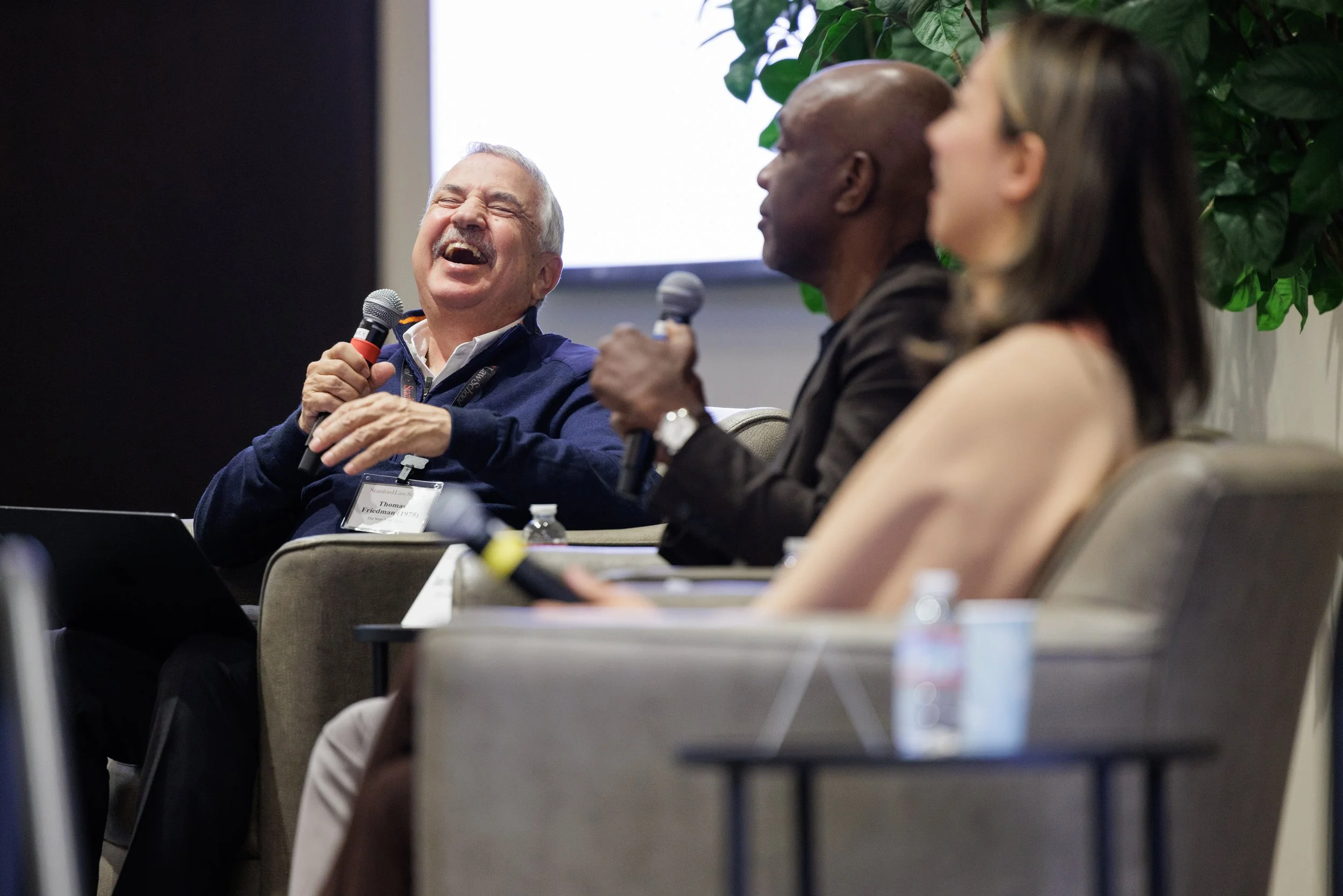
CONVERSATION | Lightly edited transcript
Thomas Friedman (Marshall Scholar 1975)
Well, welcome everybody. I'm so excited for this panel. My name's Tom Friedman. I'm the foreign affairs columnist for the New York Times. I'm joined here by my very old friend, James Manyika, who now runs basically research and labs, AI research and labs across Google and Google DeepMind. And my new friend, Clara, who built Meta's business AI practice and now runs a nonprofit helping unemployed and underemployed Gen Zs get their first job in an AI world, and it's called New Work Foundation. There are actually two kind of panels I moderate. There's ones where I come with my notes and I ask the questions, and there's ones where I come with my notebook because I intend to take as many notes as you out there in the audience.
I'm not going to waste a second here. So just to begin, Clara, I'm going to start with you.
I'm so intrigued by your new startup and how you describe it. Tell us what motivated you to do that and how it all works.
Clara Shih (Marshall Scholar 2005)
Sure. First of all, it's great to be on this panel, and this is a double reunion for me, both because I went to Stanford and also I'm a proud Marshall Scholar from 2005. So thank you so much for including me. Absolutely. So my last two roles prior to starting New Work Foundation involved building the business AI products and business for Salesforce and then for Meta. And Salesforce is more of a traditional software as a service company pivoting to become this AI first organization. And so we had to re-architect a lot of what was there to build what is now Agentforce, a billion-dollar business, doing really well in the enterprise.
On the Meta side, we were focused on the hundreds of millions of mostly small businesses that acquire customers using Facebook, Instagram, and WhatsApp. So lower end, so different aspects of the business spectrum. And what I started to notice last summer as we were preparing to launch Meta business agents and we were seeing product market fit and we were hockey sticking in product usage, which is what everyone who works in tech hopes to do, was that the more effective our products were, the fewer people our customers needed in their customer service and sales departments.
I just started to notice that last summer. And I actually got some angry messages from pilot customers who were volunteering their time to work with my team to give us product feedback. And some of them were losing their jobs. And I thought, well, that's not a good feeling because for me to hit my product goal and to drive impact, it feels a little zero sum with these partners, people who've become friends who've been volunteering their time. And then I saw in my own team, I started to, you have a lot of pressure to deliver these big numbers and we had about a thousand people in the org hiring hundreds of people every month.
And we started to just deprioritize more and more of the entry level hiring, not just in software engineering and product management, but really across the board, marketing, sales, legal, compliance, all across the board, just because it was less about a cost issue because entry level hires don't cost that much.
It was more about, it was just faster and easier in many cases to deploy an AI agent to do market research or to deploy an AI agent to write the first set of the draft code and the test code than to train up someone from scratch and started to worry about that. And then it really hit home for me when members of my own family, I have a dozen nieces, nephews, cousins between my husband and me, a number of them are in their 20s, recently graduated. A lot of them were starting to struggle with finding jobs, keeping jobs.
Even the most ambitious 20-year-old in our family, he graduated from Penn with a degree in finance and CS, even he couldn't find anything. And we started to really think, okay, is this the other side of what I'm seeing on the tech building side? And then in November when the Stanford Digital Economy Lab, I know a number of us know Erik Brynjolfsson and his lab, they published the Canaries in the Coal Mine paper showing that actually, yes, it plays out in also the data, the economic data, that entry level hiring for exposed roles is declining and they can directly attribute it back to the launch of ChatGPT.
Started to wonder, okay, what can we do about this? And so just segueing to what we're doing today, I left Meta earlier this year. I started the New Work Foundation. We're a 501 nonprofit, and we're really approaching this with an AI and startup mindset of we're going to have to try many things before we find the things that work. And so we're building a number of AI-based job search tools to help the 42% of Gen Z graduates in the US who are underemployed. So these are people who completed their four-year degree, but now are most commonly doing gig work at DoorDash, Uber, maybe data labeling, as well as the 5.6% of this population, separate of this cohort that are just entirely unemployed.
And it's a problem, not just for our families, many of us know a young person, but it's a political problem. It's a social problem because these young people, there's lots of research that shows that early career determines your lifetime earning trajectory.
It determines how soon and whether you will get married, have kids, household formation. It's our future tax base. And so that's what we're trying to do right now in this kind of non-traditional nonprofit.
Thomas Friedman
Hold on. That's really scary, if I could say.
Clara Shih
It is. It's scary. And I want to scare people sufficiently to pay attention to take action, but not to have this negative spiral, which I would say a lot of people who work in AI, it's sometimes easy to start feeling down about things. And so we have to take action. We've been in tough situations before and at private sector, public sector, NGO, academia, we've problem solved our way through before, and this is no different.
Thomas Friedman
James, if Clara called you up in the job you're working on now and asked, I'm seeing these trends, what are the trends you're seeing? And given your perspective at Google and DeepMind, what would you advise her to do as a strategy to meet this coming maybe tsunami?
James Manyika
Well, first of all, thank you. It's such an honor to be… I actually feel like a bit of an interloper. I didn't go to Stanford and I wasn't a Marshall. I was a Rhodes.
Thomas Friedman
I explained to James, we always say that Marshalls are Rhodes Scholarships for smart people. So this is the only place you'll get that abuse, James.
James Manyika
But thanks for having me. I actually think it's worth taking a closer look at those trends and I'll use, because I think while there's a lot to think about when it comes to jobs, employment, entry level hiring and so forth, I think the data's a little more worth taking a look at. First of all, even if you look at the canaries and the coal mine data, it's worth actually looking at the timing of that data because the trends that that paper describes started before the actual ChatGPT moment. So it's actually worth looking at to see what was actually going on in the labor markets, because if you look at all those charts, they start to break around October 2022 when in fact the ChatGPT moment was November 2022.
And many economists have actually looked at that and attribute some of those changes to some more monetary policy related questions and also some of the overhiring that had happened in a lot of firms before that.
So that's worth paying attention to. If you fast-forward, it's also worth taking a look at even most recently, the economist did a very good roundup in September last month on just what's actually happening in the labor markets. And they looked at a whole bunch of labor statistics from the BLS data and also the economic data. And what they actually concluded is actually something that at least matches much of the research we've been doing and also some other economists, which is if you look at… So what they summarized, just to preview very quickly, what they summarized in September was that if you look between 2023 and now at what's the most number of jobs you can attribute that have been lost to AI related effects, their number was 200,000.
And they said, if you look at what job creation can you attribute to AI since that time, their number was at least a million.
The reason why that's interesting is because a lot of us who've actually looked at this question, what will happen at the labor markets, typically have always said three things will happen. And I think we're seeing all three things that if you look at jobs as made up of tasks and any job is really an agglomeration or aggregation of several tasks, what you'll find is that yes, there'll be some occupations we should expect to decline, and we're starting to see some of that, but there'll also be jobs we should expect to grow, and we'll start to see some of that.
And some of these are jobs whose existing jobs for which the demand for them actually goes up.
Thomas Friedman
Give me some examples of each one.
James Manyika
Electricians. Look at the classic example that everybody likes to give, radiologists. Everyone presumed radiologists were going to be gone, but in fact, there's actually been a growth. So often the jobs that grow are existing jobs where the demand elasticity of those jobs is actually quite high. And so therefore, when it becomes easier for those jobs to do more, you actually see the demand go up. And then the other jobs that typically grow tend to be jobs that didn't exist before, where new activities start to happen and you start to see that. So we should expect—
Thomas Friedman
Can you give an example of that too, James, in the AI world, jobs that just didn't exist before?
James Manyika
Yeah. we're starting to see people who are prompt engineers.
Thomas Friedman
Search engine optimizer equivalent of -
James Manyika
Yeah, the things that just didn't… And often those are easier to see in hindsight, by the way, as opposed to see this at the time. I remember, fun story, I remember years ago working with Bob Solow, the economist. I remember he had us do this fun analysis where he said, "What do you think is the fastest growing job occupation in America?" And obviously we did the analysis, we went to look at the BLS tracks like 800 occupations, and he was right. The fastest job—what's that?
Thomas Friedman
Bank teller?
James Manyika
No, other. No, seriously, because at any one period, when the BLS is tracking occupations, there's always a group of occupations that haven't been classified yet that have suddenly popped into the economy, and they're always the fastest growing one. So just to finish the story, so I think, yes, we'll expect some jobs to decline. We should expect some jobs to grow of both kinds, existing and some new, but the biggest effect is that most jobs will change, and that's the biggest effect. So I think what the economist summarizes a little bit of what we're seeing. By the way, just one other factoid on the economist data that they summarized wasn't their data, they were obviously just looking at the government statistics.
The unemployment rate for people in the age 20 to 24, the unemployment rate wasn't any worse than the economy-wide unemployment rate. And it's actually that gap between the 20 to 24-year-olds and the wider economy.
It's actually the lowest gap in a few decades. So I think we're seeing a lot of change. And I think the biggest change that translates to that we're seeing even for us at Google for new entry hiring is that the content of most entry level jobs is changing quite a bit. So your typical computer scientist where much of what they've done in computer science is just coding, which by the way, is something that has happened a lot in the last decade because there's so much growth in coding dominant jobs. Your typical median college shifted the curriculum mostly to end up being computer science mostly being about coding.
But if you talk to anybody, I'm sure there's some in this room like me who did computer science years ago, decades ago, you'll remember that the coding part of what you studied is that computer science was just a small sliver.
There's so many other things you learned as a computer scientist. And so the role even of jobs that we think of as software development where we think of computer scientists, the content of them is actually shifting. And in fact, you see this in the government data, the economists also and others have pointed this out. Job growth for software developers since January is actually up.
Clara Shih
Except for entry level.
James Manyika
No, but it depends what content, what they've done. So yes, so if an entry level graduate for whom most of what they've done is coding, the demand for just people who are just coders may be down a bit, but the demand for computer scientists hasn't changed. We have open positions in computer science at Google.
Thomas Friedman
Clara, this is fascinating. I think this is a
James Manyika
Little bit of the… And I think this is important both from a training skilling and education standpoint to think about what's the content of the various courses. I think years from now, we'll still have people called engineers. I think they'll be doing vastly different things.
Thomas Friedman
So Clara, what's your reaction to that? Should I be shorting your stock? given what James has just said?
Clara Shih
Not here to give investment advice. James always brings up excellent points and I would like to address them. Some I agree with, some I disagree with, and one I'd like to build on. So in terms of the Stanford paper, yes, the trends do start before, and I want to commend Eric's team here on campus. They were very rigorous. They looked at a multitude of different factors, including the end of zero interest rate policy, post-COVID stimulus, but they've ultimately, after tracking all of the explanation coefficients for each of these variables, the highest one for the entry level was attributed directly to AI usage.
And again, I saw this because I've hired thousands of people, many of them previously were entry level, but I think the broader point is it's actually unknowable what will happen with jobs. All of us are just guessing, even the Nobel laureates are just guessing.
And so in these types of situations, I always think it's good to have a plan B. And I also think it's important, even if there is a utopia of many of these new jobs, many of which we don't know yet that appear, I think the transition period can be awfully hard for people. And I just think I was back in Ohio recently, which is where my family immigrated to. We're originally from Hong Kong, lived in Ohio. We were there for four years and my parents couldn't find work. And it turns out it was because they chose a horrible time to go to Ohio, which was in the late 80s, just as manufacturing was moving offshore.
It's interesting to talk to our former neighbors, former first grade teacher. At the time, people were sold this idea that global trade will lift all boats and that the menial tasks that people don't want to do will move offshore.
It'll mean better, higher paying, more meaningful work for Americans. in some small pockets that played out for a lot of manufacturing workers, two thirds of them ultimately never ended up finding another role in manufacturing because they were holding out hope. Many of them did not switch to the service sector, which paid less, so people didn't want to take a pay cut and have to work more hours and not have a union. And so I want to make sure that we learn from what has happened in recent history and say, okay, if this is going to be a change and these jobs are changing for the most part, some will go away, some will be enhanced, but most of them will just change.
How do we help these people through the transition first by being very honest with them about what's going on, and then second, by giving everyone the tools that they need to succeed starting in K-12 education, higher education and beyond.
James Manyika
If I could just agree with Clara, I think I agree with everything you said, which is that I think you shouldn't take what I've said to say everything will be fine. There's a lot of work to think through, because even as jobs decline and some grow and many change, the skilling requirements that are massive, the transition supports needed to make that work massive. And the transition supports in some ways is the skilling part in some ways is the easiest to talk about. It's easier to talk about reskilling and skilling. Most reskilling programs actually struggle quite a bit because often the people involved in the reskilling are often older workers and so on.
So those are not easy things to do. And the other complications that even as some jobs decline and many grow, often they're not in the same sector or the same place or the same location or the same city or the same place.
Those are massively important transitions. And then the other thing is that even if people have the right skills, historically we have not done as a country as good a job in thinking through the safety nets and the transition supports. And in globalization, that was one of the biggest failings about the inability to support the transitions and the safety nets. And in fact, arguably the US did worse at that than other OECD countries in providing those transition supports and safety nets. So these are all things we're going to have to think about. And even as in the case of globalization, even though the numbers on jobs lost in manufacturing at the national level were not that large, I think by most estimates from economists, between 1999 and 2015, the number of jobs actually lost to globalization in the China shock, this is the work that David and others did, was about somewhere in the single digit millions.
I think it was four to five million. I won't get that quite right. But they were deeply concentrated in a few sectors, in a few occupations and in a few places. So if you were in one of those occupations of places, this was devastating. This was massively devastating. And so I think these are correct. We can't just look at the aggregate net effects. These are real people in real occupations going through real change, and I think we have to find better ways to support and deal with that.
Thomas Friedman
James, what do you think are the most, and I'd ask you both this because it's really the sub-theme of this whole session, what are the most effective, the most important reskilling attributes you need in order to make this pivot?
Clara Shih
It's a real challenge because to James's point, previous job training, reskilling programs have not been successful. And this time around we have two things that make it even more difficult. The first is that AI, unlike learning a piece of machinery or learning how to use email and use the internet, AI is constantly changing. So you could learn everything there is to know about AI today, and then in a month when there's a new model, you could be obsolete. And so there's this kind of first derivative that you have to optimize for. And the second is that all of this is happening in a much more compressed timeline and across a multitude of sectors.
This time around, it's not just the coal mines, it's not just manufacturing, it's every class of knowledge work is being affected simultaneously. So there's less switchability because the places that you would normally switch, those are also being affected by AI.
And so the only thing I've been able, because we've been testing a lot of different things, the only thing I've been able to arrive at so far that I'm pretty convicted on is that even the language that we use around training programs and skilling programs, I now have an issue with because it makes the trainee a passive recipient of training that someone else gives them. What I've realized is the only way that someone can keep up and the folks that we're seeing succeed is people who say, "I'm taking responsibility. I'm the subject, not the object of this action, and I'm going to keep upskilling myself." So the question is how do you change?
A lot of K–12 education has not been teaching and rewarding that type of behavior. How do we shift the mindset first? Because once you have the right mindset, the skillset these days is pretty easy to obtain.
The great thing about AI is that AI helps coach you on how to use it. And so with the right mindset and that hunger and that commitment to sign up for this ongoing continuous learning, these are concepts we've been talking about for decades, but now it's really come to a head.
Thomas Friedman
That's fascinating. Same question.
James Manyika
I think the questions around skilling are very challenging. I think they raise some very profound questions for educational institutions because on the one hand, I think the idea that you are educating people for work, I think in some ways is a very practical, useful idea. But when the work itself is changing pretty quickly, then it gets back to other questions. So should education be more foundational? Should it be more the kind of enduring kinds of foundational understanding of science and STEM and all of these things? So I think it creates an interesting tension that we perhaps haven't had to deal with.
But I also wanted just to comment, Tom, to say, I think on the one hand, the particular innovations are moving at a blistering pace. we can talk a lot about that and about just the relentless pace of capability advances and so forth.
But I think the rate at which this is playing out into the wider economy is actually not quite as fast actually, because in fact, it's one of my biggest worries has been quite often some in our field have been making pronouncements for the last four years about wiping out white collar jobs in two years and it hasn't happened yet. So I think there's often a bit of a two speed thing about yes, technological advances are happening, but the rate at which it flows into the economy is much slower. Many economists, including Chad Jones, a Stanford economist, have always talked about this idea that they're kind of roadblocks in the economy and bottlenecks and things that slow down the adoption.
We just did, at least for now at least I'm sure somebody will do a bigger one, what's probably the biggest study looking directly into the economy through the lens that we have the benefit of the Gemini app is now used by more than a billion people monthly, and we've also got people using AI capabilities in search with AI overview.
So we did this massive look globally to see we actually published it and released the data, the Atlas study, to see what are people actually doing with this technology? And what was fascinating was on the one hand, adoption's pretty broad, but it's also very shallow. It's very shallow because if you look at are people actually completing whole tasks? Not really. Is it as deeply penetrated across all occupations of the economy? Actually, not really. In fact, the median task penetration was 21% even though adoption rates were in the high 70s across most things. This is in the US.
So there's still a shallowness to this. And it's also the reason why the shallowness to me suggests that much like some economists say the rate at which this will play out in the economy maybe a little slower than the technological progress, which is one observation.
At the same time, the benefits, because remember the reason why I think one of the reasons you want AI in the economy is to drive productivity growth and economic growth. that's one of the core arguments for this at a time when we have aging populations, but even the impact on the positive side in terms of productivity growth also hasn't quite happened yet. So even as we think about this enormous economic potential of this technology, I think other than what we're seeing through the lens of massive infrastructure investments and capital investments, which are showing up in the economy, because a big part of our current GDP growth is this capital infusion into infrastructure.
If you look to the impacts on economic growth in productivity, it hasn't happened yet. And just like if you look at the impacts of the labor markets, it's proving to be slower than we've seen.
Now, there are frontier companies who are seeing massive productivity and things, but at the level of the economy, not really yet.
Thomas Friedman
Did you want to say something about that? Then I have a follow-up question.
Clara Shih
Well, I've known James for a long time, so I'm going to disagree with him and debate him on two points.
Thomas Friedman
That's what we're here for.
Clara Shih
James is talking about we're not seeing it in the statistics yet, and there were two points that I wanted to share. One is, I agree with that, and that typically economics research is a lagging indicator of what's happening. Given an economy as large as ours, it takes a long time for us to see these effects. In the late '90s when e-commerce was just coming online and those first internet transactions were occurring, and for years after, you wouldn't have seen that show up. And so I think that we should look at this research and we should also keep in mind that it's going to be a lagging indicator.
And on the point about technology diffusion, I think that AI is unique relative to previous technology disruptions in the sense that what I saw in my experience was working with a thousand software engineers.
I didn't need all 1,000 of them to use coding agents for me to see a productivity gain. What ended up happening, how it ended up playing out was instead it was about a dozen of them, and actually it was unpredictable. I wouldn't have guessed it would be these dozen who ended up doing it. It was all across the organization. A lot of them were two to five years of experience. Very few had more than 10 years of experience. I found that those folks were more stuck in their ways of coding that made them successful the last decade or two.
And it was really these 10, 12, I'd say early mid-career engineers that each set up 50, 100 coding agents. They really drove the productivity gains. And then everyone else in the organization, about a thousand, these are really excellent software engineers, they were using more rudimentary code completion use cases And I'd say we probably saw an incremental productivity gain from them.
Maybe they're 10%, 20% more productive. And so if you zoom out from that, I don't think that we need widespread adoption the way that for the internet, you needed everybody using email or everybody learning how to use Google and these different apps. Here, because of the way that AI agents work, you can have one person, the proverbial 10X engineer now becomes 100X engineer. And so I don't think the diffusion requirement is as high as it was in the past, which is all this to say is I think that this is happening much faster than we've seen in previous disruptive waves.
Thomas Friedman
Thank you. I'm going to be really selfish. I'm leaving for Beijing tomorrow morning and for 10 days, a kind of AI trip. And I'm interested from hearing from both of you, how would you see these trends playing out there? Both these employment trends, maybe James, focusing on the research lab high-end trends and Clara more on the workforce, the future workforce from China's perspective in the age of AI. James, do you want to go first?
James Manyika
Sure. I think it is the case that in fact the countries where much of this is happening at the frontier is obviously the United States, we have most of the frontier labs here and China's behind. We can debate how far behind. I think that's an interesting question. And also how much they're closing the gap. That's also an interesting research question and how they're doing that. By the way, there's questions about how much of this is driven by distillation and other things. So there's a question there. So I think that's from a technical frontier advanced point of view.
We do know that they have limitations in the sense of compute capacity and access to the latest chips and so on. But I think if you apply it back to the economy questions, we do know that in fact adoption rates seem to be far higher in their economy than they are here.
Thomas Friedman
And what I sort of think of this trip, James, because obviously I'm not going to get into DeepSeek, into their inner sanctum. I'm interested in applied AI, how they're applying it.
James Manyika
And it gets to this adoption question because I think if the question was how do you drive economic transformation and growth from the use of AI, then I think the adoption question matters, especially if you talk about adoption in your largest sectors of your economy that drive your economy, the ones that are large. I mean that's what you need if you're going to drive GDP economic growth. Even though I think it's one thing to invent a technology, it's another to then apply, to apply and to transform an economy. And I think some ways we should be thinking about how we drive adoption and transformation across the largest sectors of our economy if we're going to get the economic gains and productivity growth we expect to see.
So I think that's one of the things I'd be curious when you come back and report, Tom, about what you're seeing in terms of application and adoption across sectors that matter in the economy.
Thomas Friedman
Clara? From what I'm reading, it would seem your startup has a big application in China for Chinese young people because when you hear about the unemployment rates among college grads there, but maybe I'm not reading it right.
Clara Shih
Yeah, I mean there's a whole thing of what's happening with young people lying flat in China. The New Work Foundation, it's a big enough problem to focus on the US alone and that's where we're scoped is just so we can be very specific and intentional about what's happening here. But there are some interesting parallels. There's also some very meaningful differences. I'm not a China expert, but based on what I've read is I think on the one hand the government is able to be much heavier handed in determining, okay, we have scarce GPU resources, scarce compute.
They have more energy because of their build out decades ago, but how they allocate it, how much of it is for military or for government surveillance, they've got the video cameras everywhere, or for health and life sciences or for certain applications. It seems like the government just has this ability and this working relationship with industry to be more coordinated across the applications.
And also the technology, it's a lot cheaper. A lot of the models are open source and so there's a little bit of a different dynamic there. I do think that medium and long term, just the demographics of the one child policy, it's different than in the world, in our country where we have more young people coming online and AI automation in a shrinking or flat lining population, you need it to sustain the society. You don't have the same issue with job loss and job transition that we might in our economy. So I think that it's to see the parallels, but also recognize the structural differences between the two economies.
James Manyika
Yeah, I was going to touch on build on something that Clara just mentioned. I think one of the things that's worth maybe bringing to this conversation, Tom, is I think for most of us, certainly for us at Google, when we think about a question I think we should all ask ourselves, which is what's the why of AI? Why are we advancing this technology in the way that we're trying to do? And I think for us, obviously on the one hand, a big part of it is to do with how do you build a technology that's useful to individuals in their everyday lives and a whole range of things you might expect access to information.
That's kind of rooted in some level in Google's founding mission to make this useful for people, for individuals. The other is the economy and we've talked about that. But a third area that we think a lot about, and there's a third and a fourth, the third area we think a lot about is just advancing science.
And I think this is probably one of the most underappreciated, incredible stories of how AI has been making already, not just recently, but quite frankly for the last decade or more, huge impacts on science.
In our case, I'm sure everybody knows about AlphaFold and all the things we're doing, but for example, Google, we've had a genomics program for 15 years using AI technology for genomics work. for example, even the human genome, when the human genome was actually first done, it was a single genomic assembly of one person. And even then there was still a remaining 8% of the genome that hadn't been completed yet. So we worked with the consortium to finish that last 8% and also recently been working with the Genomics Consortium to do the first reference pan genome, which has many more genomic assemblies.
In fact, now it's up to 200 genomic assemblies. And that's been going on for quite some time. You may have seen a couple weeks ago AlphaGenome Atlas, which we also, much like AlphaFold, made openly available to scientists everywhere. And so there's all these things in biology, in chemistry, in physics, and now mathematics that have been going on for quite some time.
And I think the benefits of that are going to be extraordinary.
Thomas Friedman
Interesting. Yeah.
James Manyika
And I think the reason…
Thomas Friedman
From a macro point of view.
James Manyika
Absolutely. Because I think when we think about AI as a technology, I think the one analogy, we always make one analogy, which is to the industrial revolution, because we're thinking about its general purpose technology characteristics, which is true. It is a general purpose technology much like electricity, the internet and so on. But it also has these other characteristics that have economic relevance, which is as an invention for making inventions. And I think if we're going to make those analogies, we should be thinking more like the enlightenment. That's when we invented microscopes and telescopes and the scientific methods, which allowed us to open up these vast new spaces of innovations and investments.
So I think the science aspect of this, which eventually translate to societal progress, I think as just as important as the general purpose use in a general purpose sense throughout the economy.
So the science work is extraordinarily exciting.
Thomas Friedman
That triggers another question. I think it's a really important point. It's what it's lifting the whole base of the society in terms of knowledge. So I have a five-year-old grandson and I was just thinking that what if he came to me and said, "Grandpa, I'd like to be a mathematician when I grow up." What do we say to him?
James Manyika
It's interesting, partly because I remember, maybe some people are aware of this, I had the honor of being asked to put together this volume, the American Academy of Arts and Sciences volume of Dædalus, special volume of Dædalus looking at AI and science.
Thomas Friedman
Can I also say, James, you were into AI before it was cool.
James Manyika
Well, back to Oxford, if people have anything, I did my PhD in AI and robotics, 30 some years ago.
Thomas Friedman
What were you thinking? Why did you possibly, this is a Marshall, Oxford, what was on your mind back then? What stimulated you to do that? And this was started in Zimbabwe, right?
James Manyika
Actually, that's true. So I'll give the brief version of it. Actually, what happened, I was very lucky. So I did my undergraduate degree at the University of Zimbabwe. And for my undergraduate thesis, I ended up working on something where… It's actually the first thing I ever published in a scientific journal. It was actually a paper titled Training and Modeling Artificial Neural Networks.
Thomas Friedman
Wow.
James Manyika
And it was published in…
Thomas Friedman
What was going on in your house, James?
James Manyika
Actually, in an odd set of circumstances, what actually happened was there was a postdoc from Canada who was visiting the University of Zimbabwe, and he was helping me think through what topics for undergraduate thesis.
And it turned out he had actually worked with the whole collection of Jeff Hinton and others in Canada, and had come from that environment. Anyway, he suggested this. Anyway, that's a short version of it. Please. So one of the things in this Dædalus volume you'll see, hopefully you all find it interesting, it's open access. It came out early this year. Most of those essays were actually completed. There's 33 scientists in there, some of it from Stanford, from anywhere who are doing this extraordinary work on AI and science. If you had looked up until that point in January when most of those essays were completed, not much had happened yet really in mathematics because a lot of the AI applications to mathematics up until that point were mostly these international math Olympiad problems with the mathematicians in the room will know that these are really high school problems.
Whereas in science and in the natural sciences and life sciences and physical sciences, we'd already had a Nobel Prize caliber breakthroughs, AlphaFold and other things. But that story changed dramatically in the last six or eight months in mathematics. So I think mathematics is still an interesting area. There's still more questions to ask. I think most of the advances you see have been on longstanding existing problems, whether it's Erdős problems or the millennium challenge problems, which people are now working through. But you'll see that in most of those cases, these are longstanding problems as opposed to new problems.
We haven't yet had AI system propose new conjectures, for example, that hasn't fully happened yet. These are mostly proofs of existing challenges and problems. Even then there's still some big ones out there still like the Riemann hypothesis and others that are still lurking out there. So I think there's still a lot to do in mathematics.
I think the field is going through an interesting time about this. It's actually quite interesting talking to mathematicians. Obviously many are deeply concerned and anxious about this, but I also know some who are quite excited about this and say, oh, okay, now we can move on to other kinds of problems and other kinds of questions.
Thomas Friedman
Clara, what would you tell my five-year-old grandson?
Clara Shih
I would tell him that it is very important that we retain the depth of expertise in each of these core areas. How many of you have watched the movie Idiocracy? That's a takeaway. It's a very entertaining movie, but it's also eerily prescient. It was popular in the '90s and basically talks about a society a few generations after something like AI was super genius and created abundance for everyone. And at this point in society, everyone has kind of gotten dumb because they didn't have to earn, they didn't have to think, food was just given to them, they had abundance, but they're not smart.
Some of the machines that automated everything start to break down and no one knows how to fix it. And for that reason, I think that is still very important for us to have human expertise in these core areas and that the mathematicians of today and next year are different than the mathematicians of maybe the last decades in the sense that they will need to be AI experts to help them learn a wider swath of mathematical branches so that they have the general skills and thinking across multiple domains, not just a specific domain of mathematics in order to come up with a next set of questions, in order to come up with a next set of applications, be those applications be in engineering or scientific discovery.
James Manyika
I would add one other quick comment to this, which is also particularly in the sciences, one of the things that scientists we're finding, we have a huge science program at Google and Google DeepMind, and we collaborate deeply with academic scientists. In fact, if you look at most of our papers in science, we're co-authoring with academic scientists. I think the new bottlenecks, I'll illustrate this as an example. One of our AI systems, we've used it to predict crystal structures, for example, for new materials. And in fact, it came up with in the last published paper that we had something like over two million potential crystal structures.
But most of those we know are not stable enough to be synthesized. And in fact, when we start to look at those kinds of question, the number fell pretty dramatically from the 2.2 million crystals that we predicted to a few thousand.
So you're starting to see in some ways a huge bottleneck emerging around verification. So it's one thing to do experiments and predictions in silico is quite another to then do lab verification. We worked, for example, I'm sorry, there's another university with Yale, for some work we're doing in cancer pathways. And in this paper, we predicted these enormous possibilities in cancer pathways. And it turned out that when we then touched the verification, many of those were actually, quite frankly, not very useful. Some of those were known already, but there were four that seemed novel and interesting.
And then in a lab verification, one turned out to be incredibly novel. So I think this idea of generating possibilities and hypotheses, I think that's going to be, quite frankly, easy. The verification part is going to be a massive bottleneck. So I think we're going to start to see different kinds of bottlenecks and challenges, and then the shift go from framing questions, framing explorations and ideas.
I think we're going to see that quite a bit.
Thomas Friedman
Interesting. We have to close, so I'll just ask one closing question because there's now a meta debate in the country about AI regulation too slow, too fast. And my view is that there are vintage years in wine and there are vintage years in history. And 2027 is going to be the Château Margaux of historical years because if everything I'm hearing is right, that we will be at 100%, whether Gemini, Anthropic or OpenAI, 100% recursive self-learning. I have two questions. One question is what does it mean for us and how do we deal with the regulation side of that?
And the other is I thought of writing a movie script and it would be called six months in 2027. And what I mean by that is what if we get there six months before China? What does that mean? Clara?
Clara Shih
I believe very strongly we're living in the biggest labor disruption of our lifetimes, of any lifetime. And we can debate all day long how many years we have or which sectors, but it's happening and we need to start preparing. We are going to have to test many things at the policy level, at the employer level, at the education level before we find the right solution. And so I'd love to see less time debating how long it's going to take and more time just trying things and less time fighting and more time finding where we agree that there are issues and take lessons learned from what we did wrong in the manufacturing shock and do better this time.
And as for 2027, I think if we can do that, then we will be better prepared for what comes because it will be shocking for many people.
In terms of US versus China, I think that's the challenge right now in terms of pacing. A lot of the labs talk about pacing. It's very difficult because the labs are competing against each other for spend, largely enterprise spend and also consumer usage. And so there's an incentive to go fast there. And then geopolitically, we're competing with China to see who can get there first because there is this belief that it'll be a winner take all. And so I think it's going to be very challenging, but there is this, we have precedent as we were talking about before, for can we find common ground around preventing mutually assured destruction?
Can we start to put those in place, the trip wires and work together because we really don't have any other choice.
James Manyika
I think I'll say a few things. I think it's going to be, you mentioned recursive self-improvement and those kinds of techniques, which in some ways we're starting to see some of that already. I think a focus on safety is going to be super important. We've always had this view that capability advances should not outrun safety and alignment and those kinds of things. So for us, those two things have to go together, have to be pacing and advancing together.
Clara Shih
But how do you balance that with the capitalism that we live in and then also the geopolitical race?
James Manyika
No, I think it's a responsible thing to do. And we are trying to do that. the way we are thinking about model releases and those kinds of things, we're trying to make sure those two thing capability advances and safety and responsibility go together. Are we going to get it perfectly right every single time? No. Is it important to try? That's what we're trying to do. The other thing I'd say on the race question, and we're on record, we've said this a few times over the last few years, but maybe it's more important to say it now, which is we've always felt and stated quite publicly that the only race we want to be in is the race to get it right.
And for us, the race to get it right has two parts to it. It has this idea that can we be incredibly ambitious about what we put this technology, what uses we put this technology to?
So that's a big part of the things we're trying to do for individuals with languages, with science, with solving societal challenges like predicting everything, diseases and floods and all of these things that we're doing. By the way, you're welcome to read through what we're doing there. We have had fairly ambitious goals. One of them, just to pick an example, is we have this moonshot say, wouldn't it be great if no person or community was ever surprised by a natural event? So we've been working down everything from floods to monsoons and wildfires and cyclones and so on.
So for us, we see the need to be as ambitious as possible on what we put this technology to. At the same time, be responsible. The questions about safety, questions about can we actually innovate on the safety side as well? So for us, innovation is not just about the capabilities.
So for example, we're glad that many other companies are now inventing this watermarking technology SynthID, which we're glad that many others have now adopted SynthID, a way to watermark indelibly anything that's synthetically generated, for example. So for us, that's the race we think we're in to get it right, and that's what we're trying to do. On the question about regulation, I think there's several pieces to that that we think matter enormously. One of them is the idea of standards, about whether standards about the performance of these systems, the safety of these systems, et cetera. That's something we've always been big advocates for, and I think that we think that's important.
We've also been on record for saying things like we think this technology is too important not to regulate. It's also too important not to regulate well. So I think all of those things are true.
So I think we're going to have to solve these things both as companies and labs to do this responsibly, but also as some mechanism that allows at least at the national level to have a mechanism for standards or evaluations or have third parties come look at what we're building and all of those things. We have to find at least a mechanism to do that that has some outside in and even government and federal oversight for that. And then I'll leave the geopolitical questions to you, Tom.